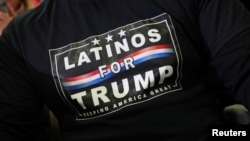
Although projected to lose the U.S. election, President Donald Trump made the race closer than expected, in part by gaining a higher percentage of minority voters this time around, especially in the growing Latino or Hispanic population, than he did in 2016.
The increase nationally in the Hispanic vote for Trump, from 28% in 2016 to 32% this year according to exit polls, refuted the assumption by many Democrats that Latinos would vote overwhelmingly against Trump based solely on his harsh anti-immigrant rhetoric and policies.
"I think that we've got to, going forward, really disaggregate that Latino vote. It is not a [singular] vote," said Elaine Kamarck, a political analyst at the Brookings Institution.
Republican values
Despite Trump's improved showing, Latinos backed Biden roughly 2-to-1, with many expressing strong opposition to the Trump administration's policy of separating migrant children from their families at the U.S.-Mexico border.
The Hispanic electorate, however, is overwhelmingly Catholic or conservative Christian, with many in agreement with Trump and the Republican Party's opposition to gay marriage and abortion.
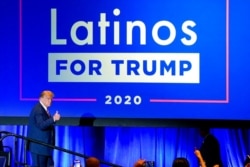
"Being pro-life, that's primarily one of the biggest reasons I voted for Donald Trump," said Maria Posada, an engineer of Mexican descent, who was born in Texas.
Some fiscally conservative Hispanics also liked Trump's pro-business initiatives of lowering federal taxes and reducing government regulation, and discounted the Democrats' repeated promises to increase wages, expand access to health care and fix America's broken immigration system.
"We Latinos believe that no matter what they say, offering the moon and the stars, they will not keep their promises," said Nelson Reynaldo, a contractor in Virginia, who came from El Salvador.
Florida and Texas
A surge of Latino support helped Trump win Florida with over 51% of the vote, defying some pre-election polls that had Biden ahead by as much as five percentage points.
Many Americans of Cuban and Venezuelan backgrounds left countries they considered to have been ruined by socialist policies.
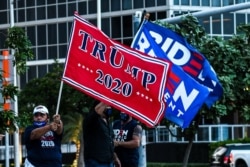
Trump's tough trade restrictions imposed on communist Cuba and efforts to depose Venezuela's socialist leader Nicolas Maduro resonated with many Cuban American and Venezuelan American voters in Miami.
The Trump campaign's efforts to cast Democrats as socialist may also have "mobilized a lot of Cuban-Americans," said Sergio Garcia-Rios, a professor of government and Latino studies at Cornell University.
Biden, a long-time senator and former President Barack Obama's vice president, is considered a political moderate. But some progressives in his Democratic Party have embraced the title of democratic socialist in calling for major government-funded programs to expand health care and combat global warming.
According to exit polls, around 55% of Florida's Cuban American vote went to Trump, along with 30% of Puerto Ricans. In 2016, Trump won only four out of 10 of the state's Latino voters in his race against Democratic nominee Hillary Clinton.
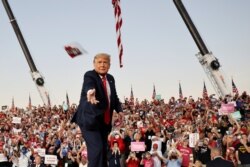
Some Latino advocates say Biden neglected Florida for much of the campaign, while Trump held multiple rallies in the state, which many political observers regarded as a "must win" for Trump but of less importance to Biden's path to the White House.
"Biden really was kind of late to the party," said Claudia Ruiz, a policy analyst with UnidosUS, the nation's largest Latino rights advocacy organization.
The Biden campaign has in past weeks disputed criticism from some Democrats that it was not sufficiently focused on this demographic.
Trump also won decisively in Texas with over 52% of the vote, despite pre-election polls indicating a close race in this southern border state with a rapidly growing Latino population.
Four in 10 Hispanics voted for Trump in Texas, up from three in 10 in 2016, according to exit polls in that state. Many Trump voters cited economic opportunity as their top issue, while Biden supporters prioritized combating the coronavirus pandemic.
Monolith cliché
The increase in support for Trump in this election, analysts say, reflects the growing diversity in economic level, education, political leanings, immigration history and country of origin among Hispanics in America.
"We are not a monolith," said Albert Morales, political director for the polling firm Latino Decisions.
At the same time, Trump's gains among Latinos, who gave him 32% of their votes, still fell below the 40% share won by past Republican presidents Ronald Reagan, George H. W. Bush and George W. Bush.
And while the Latino vote helped Trump win in Florida and Texas, it also helped Biden flip traditionally Republican states Arizona and Georgia. Growing Hispanic populations played a factor in almost every state, including the key states that decided this election in Biden's favor — Pennsylvania, Michigan and Wisconsin.
"There isn't a state now where we're not relevant," said Morales.
Exit polls conducted by Edison Research also showed that about 11% of African Americans and 30% of Asian Americans voted for Trump, up three percentage points from 2016 in both groups.