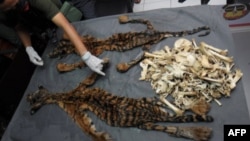
China unveiled new rules on Monday that would allow the use of rhino horn and tiger parts for some medical and cultural purposes, watering down a decades-old ban in a move conservation group WWF said could have "devastating consequences."
China's State Council issued a notice replacing its 1993 ban on the trade of tiger bones and rhino horn. The new rules ban the sale, use, import and export of such products, but allow exceptions under "special circumstances," such as medical and scientific research, educational use, and as part of "cultural exchanges."
Horns of rhinos or bones of tigers that were bred in captivity could be used "for medical research or clinical treatment of critical illnesses," it said.

Rhino horn and tiger products classified as "antiques" could be used in "cultural exchanges" with the approval of culture authorities, although they still may not be sold on the market or exchanged via the internet.
The new rules came into effect Oct. 6.
WWF said in a statement that Beijing's move would have "devastating consequences globally" and be "an enormous setback to efforts to protect tigers and rhinos in the wild."
"Even if restricted to antiques and use in hospitals, this trade would increase confusion by consumers and law enforcers as to which products are and are not legal, and would likely expand the markets for other tiger and rhino products," WWF said.
Beijing banned trade in tiger bones and rhino horns, both prized in traditional Chinese medicine, 25 years ago as part of global efforts to halt declining animal stocks. But illegal poaching has continued, driven by demand in an increasingly affluent country.
Commercial tiger farms in China are legal, and although using tiger bones in medicine was banned, tiger parts from these farms often end up being made into tonics or other medicines, animal rights groups say.
Conservation groups say Chinese traditional medicine recipes can make use of substitutes for products from wild animals. Some Chinese officials have in the past said full bans on the use of wild animal parts would threaten traditional Chinese medicine.