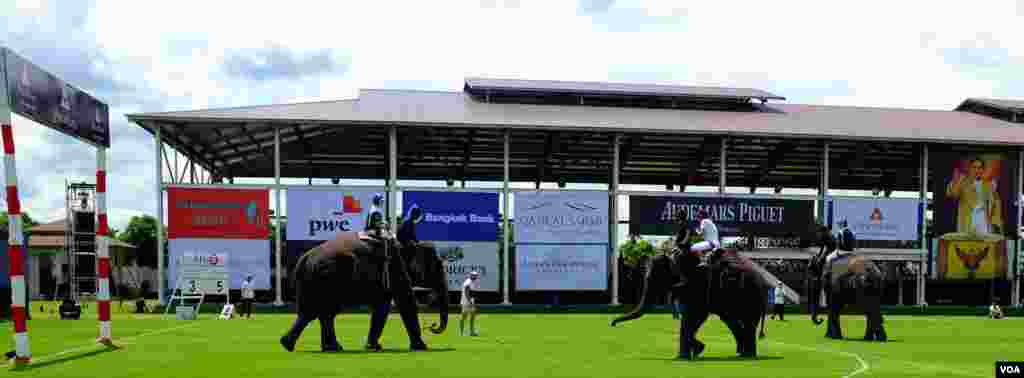
Polo, the ancient team competition typically played on horseback, is known as the “sport of kings.” However, the royal version for one annual event, now underway in Thailand (through Sunday), swaps the horse for the kingdom’s national symbol - the elephant. The King’s Cup Elephant Polo tournament in Samut Prakan is all for a good cause.
The star athletes of this tournament are 51 teenage females, each weighing about three tons (3,000 kilograms).
Mounted on each elephant on the polo field are two relatively miniscule humans - the mahout, who steers, and the player, who gives directions.
This is the 13th year the tournament, created and organized by the Anantara resort hotel chain, has been played in Thailand. The only other games played under the auspices of the World Elephant Polo Association are the annual world championships in Nepal.
Elephants Play Polo in Thailand Tournament
1/9An elephant competing for Citibank moves its trunk toward the goal line, 2014 King's Cup Elephant Polo Tournament in Samut Prakan province, on the outskirts of Bangkok, Aug. 28, 2014. (Steve Herman/VOA).
Polo, the ancient team competition typically played on horseback, is known as the “sport of kings.” However, the royal version for one annual event, now underway in Thailand, swaps the horse for the kingdom’s national symbol - the elephant.
Show moreShow less
2/9A prayer ceremony opens the elephant polo match. Director Tim Boda is flanked by Thailand's last remaining Kru Ba Yai (elephant spirit men), 2014 King's Cup Elephant Polo Tournament in Samut Prakan province, on the outskirts of Bangkok, Aug. 28,
Polo, the ancient team competition typically played on horseback, is known as the “sport of kings.” However, the royal version for one annual event, now underway in Thailand, swaps the horse for the kingdom’s national symbol - the elephant.
Show moreShow less
3/9A Thai dance troupe poses prior to the elephant polo match, 2014 King's Cup Elephant Polo Tournament in Samut Prakan province, on the outskirts of Bangkok, Aug. 28, 2014. (Steve Herman/VOA).
Polo, the ancient team competition typically played on horseback, is known as the “sport of kings.” However, the royal version for one annual event, now underway in Thailand, swaps the horse for the kingdom’s national symbol - the elephant.
Show moreShow less
4/9Dancers performing to kick off the elephant polo match, 2014 King's Cup Elephant Polo Tournament in Samut Prakan province, on the outskirts of Bangkok, Aug. 28, 2014. (Steve Herman/VOA).
Polo, the ancient team competition typically played on horseback, is known as the “sport of kings.” However, the royal version for one annual event, now underway in Thailand, swaps the horse for the kingdom’s national symbol - the elephant.
Show moreShow less
5/9The stick for elephant polo measures two meters long, 2014 King's Cup Elephant Polo Tournament in Samut Prakan province, on the outskirts of Bangkok, Aug. 28, 2014. (Steve Herman/VOA).
Polo, the ancient team competition typically played on horseback, is known as the “sport of kings.” However, the royal version for one annual event, now underway in Thailand, swaps the horse for the kingdom’s national symbol - the elephant.
Show moreShow less
6/9A monk blesses the elephants prior to the start of the polo match, 2014 King's Cup Elephant Polo Tournament in Samut Prakan province, on the outskirts of Bangkok, Aug. 28, 2014. (Steve Herman/VOA).
Polo, the ancient team competition typically played on horseback, is known as the “sport of kings.” However, the royal version for one annual event, now underway in Thailand, swaps the horse for the kingdom’s national symbol - the elephant.
Show moreShow less
7/9This year's lineup is composed of 51 elephants, all relatively docile teenage females, 2014 King's Cup Elephant Polo Tournament in Samut Prakan province, on the outskirts of Bangkok, Aug. 28, 2014. (Steve Herman/VOA).
Polo, the ancient team competition typically played on horseback, is known as the “sport of kings.” However, the royal version for one annual event, now underway in Thailand, swaps the horse for the kingdom’s national symbol - the elephant.
Show moreShow less
8/9The female teenage pachyderms on parade prior to the start of the annual polo event, 2014 King's Cup Elephant Polo Tournament in Samut Prakan province, on the outskirts of Bangkok, Aug. 28, 2014. (Steve Herman/VOA).
Polo, the ancient team competition typically played on horseback, is known as the “sport of kings.” However, the royal version for one annual event, now underway in Thailand, swaps the horse for the kingdom’s national symbol - the elephant.
Show moreShow less
9/9Two elephants head for the ball in a game played at a much slower pace than horse polo, 2014 King's Cup Elephant Polo Tournament in Samut Prakan province, on the outskirts of Bangkok, Aug. 28, 2014. (Steve Herman/VOA).
Polo, the ancient team competition typically played on horseback, is known as the “sport of kings.” However, the royal version for one annual event, now underway in Thailand, swaps the horse for the kingdom’s national symbol - the elephant.
Show moreShow less
Previous slide
Next slide
For those who also participate in the more conventional version on horseback, the slower game of elephant polo requires a significant adjustment, as Dubai-based player Wael Soueid, explains.
“First, you don’t have control of the elephant because there’s a mahout who is guiding it," he said. "Second, is the language because the mahout speaks only Thai. And the stick is very long. It’s two meters long while the stick of [horse] polo is at 1.20. So that’s a big difference.”
These captive-born, super-size athletes are bred as working elephants and loaned to the corporate teams by their owners, allowing the intelligent mammals a change of pace.
Tournament organizer Tim Boda says the females seem to catch on to the spirit of competition.
“A lot of these elephants have been playing now for years. I do not speak elephant but watching them, first of all, it looks like they’re having a whole lot of fun," he said. "It may well be that they actually to understand the rules. Who knows?”
Spectators can enjoy the matches while chomping on gourmet wagyu beef burgers, sipping champagne and puffing cigars. But this is more than just a spectacle for the elite. The annual tournament raises money for the care of Thailand’s domesticated and wild elephants.
Proceeds from this year’s tournament are expected to take total donations over the $1 million mark.