Accessibility links

Breaking News

European Space Probe Safely on Comet After Bumpy Landing

update
This OSIRIS wide-angle camera image shows the position of Rosetta’s lander Philae (circled) on Nov. 12, 2014. (Courtesy: European Space Agency, photo released Nov. 13, 2014)
1/10 This OSIRIS wide-angle camera image shows the position of Rosetta’s lander Philae (circled) on Nov. 12, 2014. (Courtesy: European Space Agency, photo released Nov. 13, 2014)
Rosetta’s lander Philae is safely on the surface of Comet 67P/Churyumov-Gerasimenko, as these first two CIVA images confirm. One of the lander’s three feet can be seen in the foreground. The image is a two-image mosaic, Nov. 13, 2014. (Courtesy: European Space Agency, photo released Nov. 13, 2014)
2/10 Rosetta’s lander Philae is safely on the surface of Comet 67P/Churyumov-Gerasimenko, as these first two CIVA images confirm. One of the lander’s three feet can be seen in the foreground. The image is a two-image mosaic, Nov. 13, 2014. (Courtesy: European Space Agency, photo released Nov. 13, 2014)
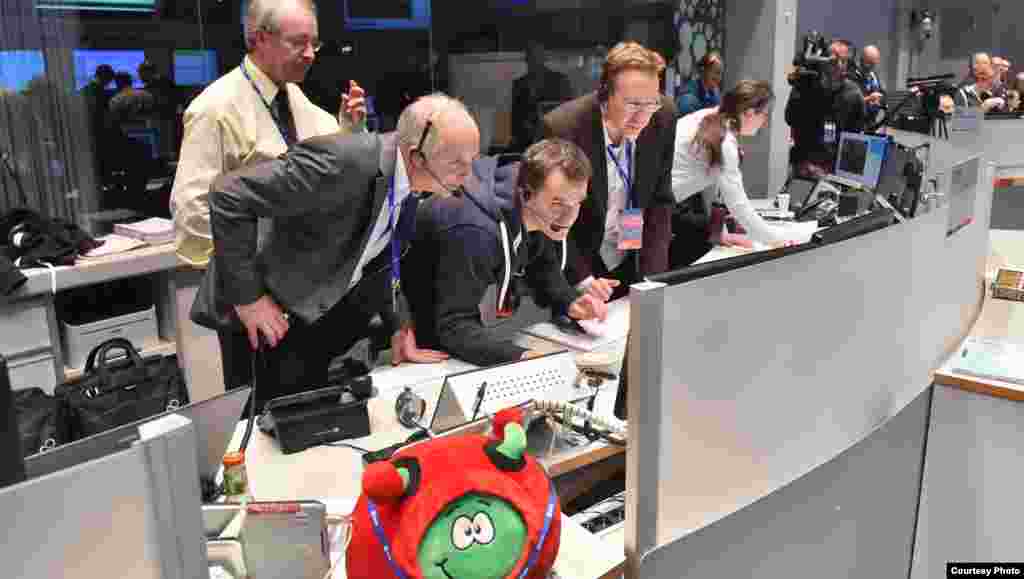
Smiles in the Main Control Room at ESA's Operations Center, as separation of the Philae lander from ESA Rosetta orbiter is confirmed and the Philae lander on its way to becoming the first spacecraft to touch down on a comet, Nov. 12, 2014. (Courtesy: Euro
3/10 Smiles in the Main Control Room at ESA's Operations Center, as separation of the Philae lander from ESA Rosetta orbiter is confirmed and the Philae lander on its way to becoming the first spacecraft to touch down on a comet, Nov. 12, 2014. (Courtesy: Euro
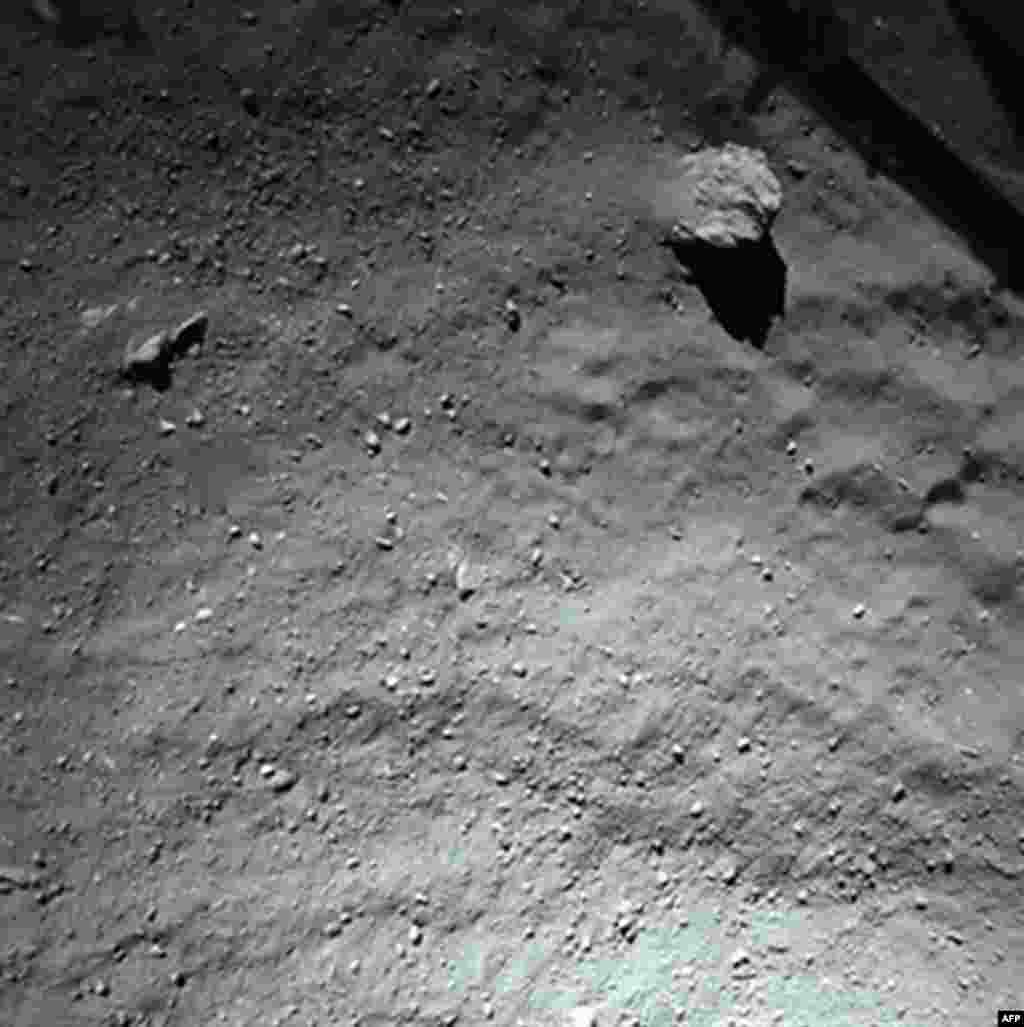
A handout photo released on November 13, 2014 by the European Space Agency, and taken by the Rosetta Lander Imaging System instrument, shows the surface of comet 67P/Churyumov-Gerasimenko during Philae's descent, from a distance of approximately 40 meters above the surface. (Courtesy: European Space Agency)
4/10 A handout photo released on November 13, 2014 by the European Space Agency, and taken by the Rosetta Lander Imaging System instrument, shows the surface of comet 67P/Churyumov-Gerasimenko during Philae's descent, from a distance of approximately 40 meters above the surface. (Courtesy: European Space Agency)
Receipt of signal from comet surface just after Philae landed, Nov. 12, 2014. (Courtesy: European Space Agency)
5/10 Receipt of signal from comet surface just after Philae landed, Nov. 12, 2014. (Courtesy: European Space Agency)
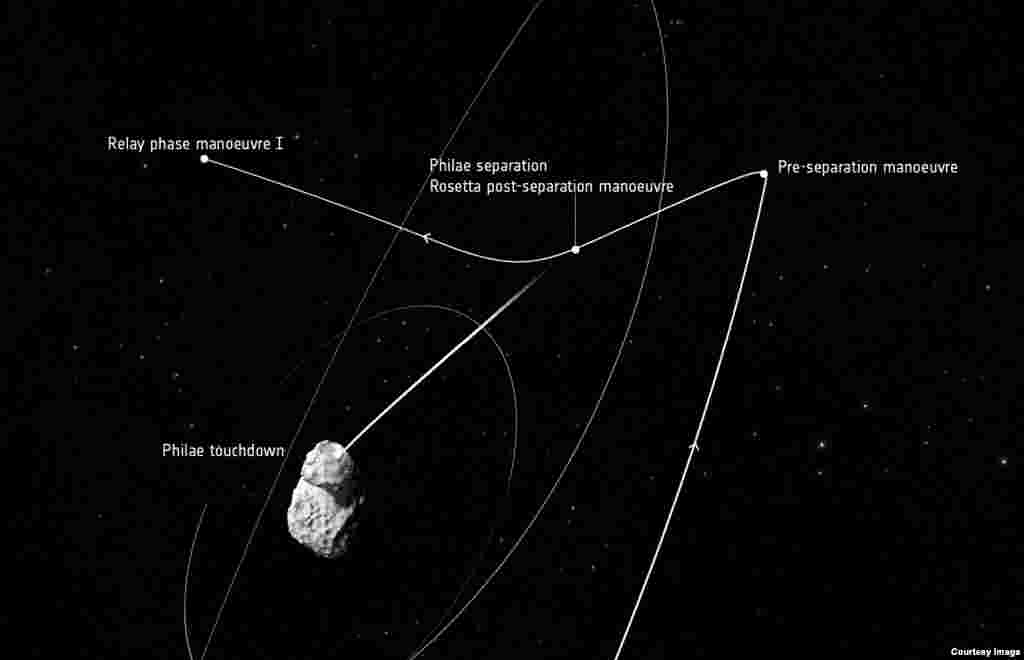
Trajectory of Rosetta’s orbit, focusing on the maneuvers of Nov. 12. (Courtesy: European Space Agency)
6/10 Trajectory of Rosetta’s orbit, focusing on the maneuvers of Nov. 12. (Courtesy: European Space Agency)
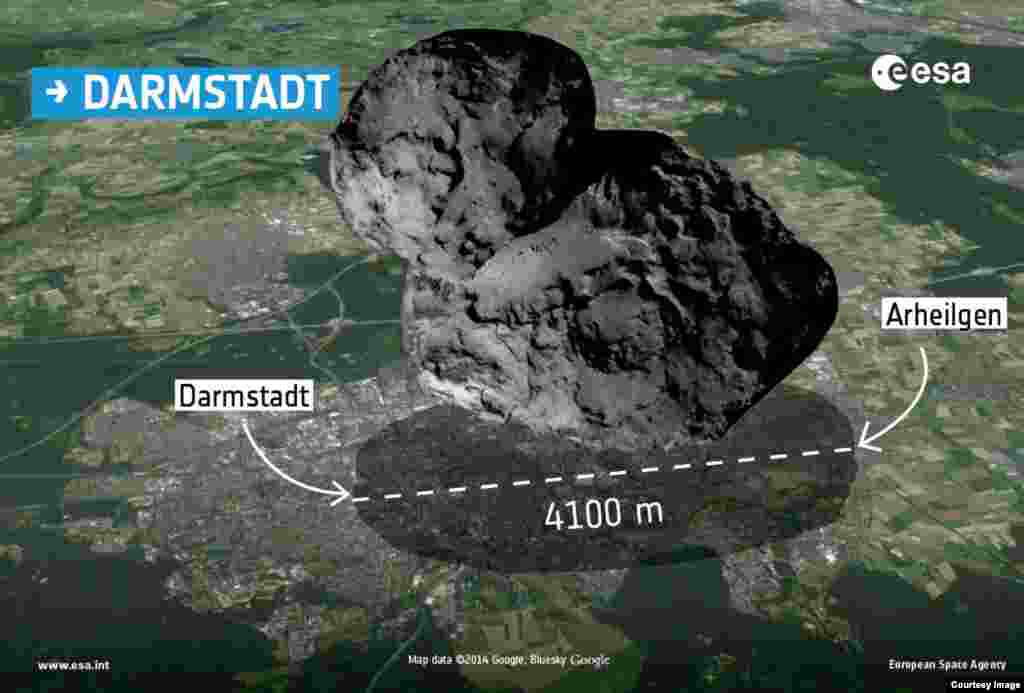
Comparing the size of Comet 67P/Churyumov–Gerasimenko with the city of Darmstadt, Germany, home to the European Space Operations Center. (Courtesy: European Space Agency, Google maps)
7/10 Comparing the size of Comet 67P/Churyumov–Gerasimenko with the city of Darmstadt, Germany, home to the European Space Operations Center. (Courtesy: European Space Agency, Google maps)
Artist impression showing Philae separating from Rosetta and descending to the surface of comet 67P/Churyumov-Gerasimenko. (Courtesy: European Space Agency)
8/10 Artist impression showing Philae separating from Rosetta and descending to the surface of comet 67P/Churyumov-Gerasimenko. (Courtesy: European Space Agency)
This image from Rosetta’s OSIRIS narrow-angle camera is marked to show the location of the first touchdown point of the Philae lander. It is thought that Philae bounced twice before settling on the surface of Comet 67P/Churyumov-Gerasimenko, Nov. 12, 2014. (Courtesy: European Space Agency)
9/10 This image from Rosetta’s OSIRIS narrow-angle camera is marked to show the location of the first touchdown point of the Philae lander. It is thought that Philae bounced twice before settling on the surface of Comet 67P/Churyumov-Gerasimenko, Nov. 12, 2014. (Courtesy: European Space Agency)
Celebrating scientists in the main control room appear on a video screen at the European Space Agency after the first unmanned spacecraft Philae landed on a comet called 67P/Churyumov-Gerasimenko, in Darmstadt, Germany, Nov. 12, 2014.
10/10 Celebrating scientists in the main control room appear on a video screen at the European Space Agency after the first unmanned spacecraft Philae landed on a comet called 67P/Churyumov-Gerasimenko, in Darmstadt, Germany, Nov. 12, 2014.
Previous slide
Next slide

Officials with the European Space Agency say a small probe is definitely resting on the surface of a distant comet after a rough and uncertain landing.

The agency released a picture early Thursday taken by the probe Philae of the rocky surface of Comet 67P/Churyumov-Gerasimenko. The photo suggests Philae is sitting at an angle, though ground controllers say the probe is working well and transmitting data.

Scientists say the probe is situated in the shadow of a cliff, however, with two feet on the surface of the comet and one foot in open space. They said attempts will be made over the next day to modify the orientation of the lander and better position its solar panels.

Philae became the first-ever man made object to land on a comet when it touched down Wednesday, seven hours after separating from its Rosetta mothership. ESA officials say the probe bounced on the surface at least once because its harpoons, which were designed to anchor Philae to the surface, failed to deploy.

The landing was the climax of a 10-year, 6 billion-kilometer journey from Earth. Rosetta had to slingshot three times around Earth and once around Mars before it could work up enough speed to reach the comet, which it did in August.

Scientists hope that samples drilled out from the comet will unlock details about how the planets evolved. Comets date to the formation of the solar system 4.6 billion years ago. Scientists suspect impacting comets delivered water to the young Earth.

Rosetta and the Philae craft have cameras and nearly two dozen instruments to probe the comet's surface — and to analyze the material below it.

The box-shaped, 100-kg (220-pound) Philae landed on the comet around 16 hours Universal Time (11 a.m. EST) Wednesday, seven hours after separating from Rosetta.

The mission was considered risky because of the unknown surface of the comet and a problem with the thruster that was supposed to keep the probe from bouncing back into space.

Rosetta’s OSIRIS narrow-angle camera Comet 67P/Churyumov-Gerasimenko, Aug. 3, 2014.

Engineers designed the lander not knowing what type of terrain they would find on the comet's surface. Rosetta has been taking pictures of the comet and collecting samples from its atmosphere as it approaches the sun, showing it was not as smooth as initially hoped.

The team had to release the three-legged lander at exactly the right time and speed because there was no way of controlling it on its descent.

The touchdown is a first in space history. It is a proud moment for European space research and, as ESA Director General Jean-Jacques Dordain pointed out, for mankind.

"This is a big step for human civilization. This is certainly terrestrial intelligence," said Dordain.

Some information for this report was provided by Reuters. Lisa Bryant contributed from Paris.

  • 16x9 Image

    VOA News

    The Voice of America provides news and information in more than 40 languages to an estimated weekly audience of over 326 million people. Stories with the VOA News byline are the work of multiple VOA journalists and may contain information from wire service reports.

This item is part of
XS
SM
MD
LG