Accessibility links

Breaking News

North American, Asians Treated to 'Blood Moon'

A photographer on a  Ferris wheel catches the image of he Earth's shadow crossing the moon during a total lunar eclipse in Tokyo, Japan, Oct. 8, 2014.
1/5 A photographer on a  Ferris wheel catches the image of he Earth's shadow crossing the moon during a total lunar eclipse in Tokyo, Japan, Oct. 8, 2014.
 A couple on a Ferris wheel observes the Earth's shadow crossing the moon during a total lunar eclipse in Tokyo, Japan, Oct. 8, 2014.
2/5  A couple on a Ferris wheel observes the Earth's shadow crossing the moon during a total lunar eclipse in Tokyo, Japan, Oct. 8, 2014.
This lunar eclipse is also called a "Blood Moon" because of its red appearance, Washington, DC, Oct. 8, 2014. (Dimitris Manis/VOA)
3/5 This lunar eclipse is also called a "Blood Moon" because of its red appearance, Washington, DC, Oct. 8, 2014. (Dimitris Manis/VOA)
The Earth's shadow begins to cross over the moon during the total lunar eclipse, as it goes behind a weathervane shaped like a Spanish galleon on the Freedom Tower, in Miami, Florida, Oct. 8, 2014.
4/5 The Earth's shadow begins to cross over the moon during the total lunar eclipse, as it goes behind a weathervane shaped like a Spanish galleon on the Freedom Tower, in Miami, Florida, Oct. 8, 2014.
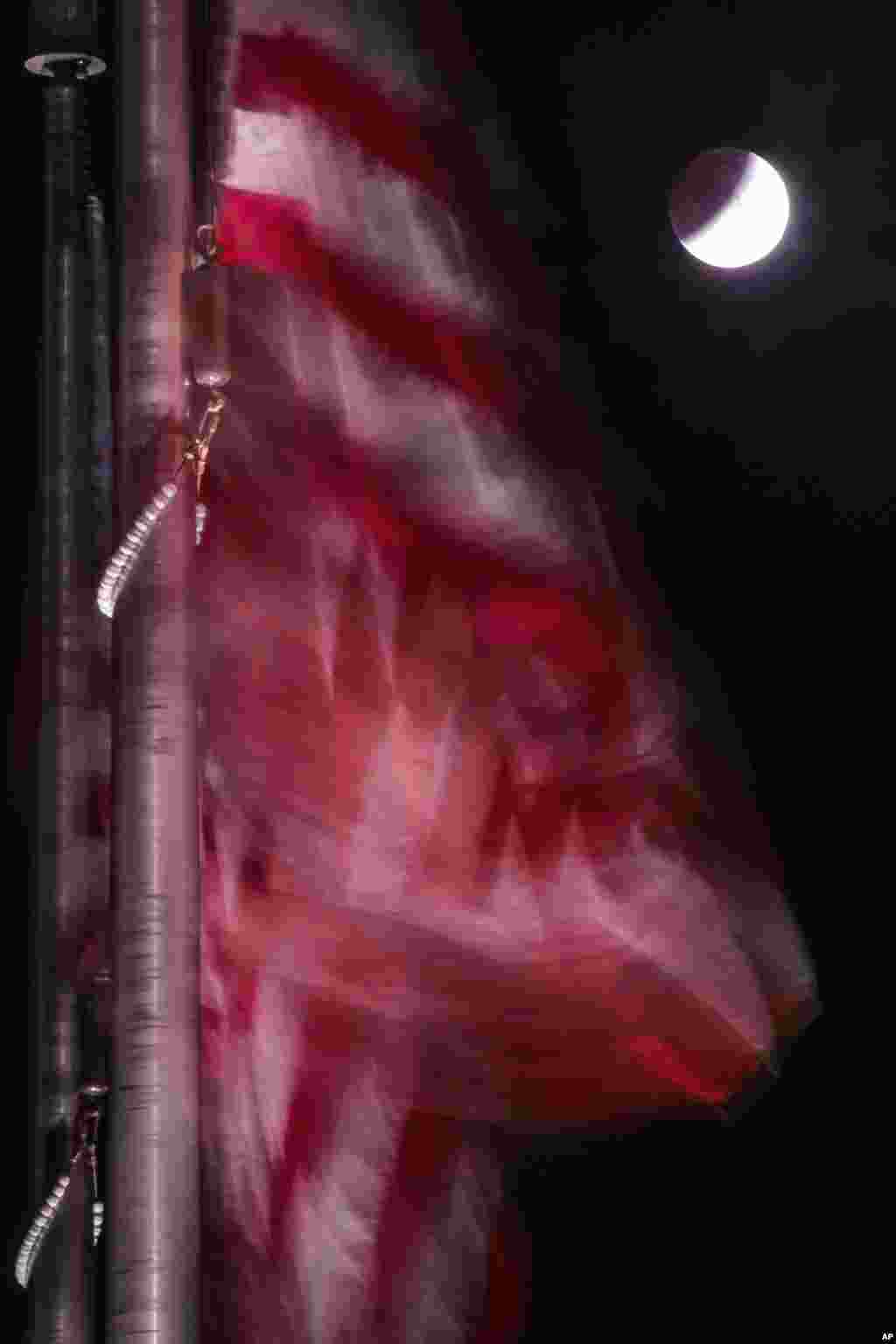
American flags blow in the breeze as a lunar eclipse projects the Earth's shadow onto the moon, near the Washington Monument in Washington, DC, Oct. 8, 2014.
5/5 American flags blow in the breeze as a lunar eclipse projects the Earth's shadow onto the moon, near the Washington Monument in Washington, DC, Oct. 8, 2014.
Previous slide
Next slide

Those in North and South America and most parts of East Asia were being treated Wednesday to a rare total lunar eclipse known as a blood moon.

The lunar landscape glowed a coppery red color as the Earth passed between the sun and the moon, shortly before sunrise in the Americas and just after moonrise in Asia.

The red color is a result of sunlight passing through the Earth's atmosphere, where it is scattered before being reflected by the moon.

It is the second of four total lunar eclipses occurring over a two-year period. The next will occur on April 4 and September 28 of next year.

Unlike solar eclipses, lunar eclipses last for several hours and are visible to a much greater section of Earth. NASA says the only places where Wednesday's eclipse was not visible was Africa, Europe, and eastern Brazil.

Public viewings were being held in China, Japan, Australia, and elsewhere. NASA and others have also set up live video feeds to view the phenomenon.

  • 16x9 Image

    VOA News

    The Voice of America provides news and information in more than 40 languages to an estimated weekly audience of over 326 million people. Stories with the VOA News byline are the work of multiple VOA journalists and may contain information from wire service reports.

This item is part of
XS
SM
MD
LG