



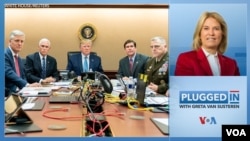
(COLD OPEN)
On Plugged In…
Anger directed at US troops …
pulling out of Northern Syria…
Leaving Kurdish fighters …
Who fought with America against ISIS …
on the run …
from Turkish bombing.
Where does the decision...
to pull US troops out of Syria...
leave Kurdish allies…
who fought and died…
alongside Americans?
((Pres Donald Trump))
"The Kurds are very well protected, plus they know how to fight. And by the way, they're no angels."
Did the United States betray an ally?
And is the dream of a Kurdish homeland still viable?
Plugged in examines the Kurdish conundrum…
On Kurds: the Search for Peace and Stability.
(GRETA)
Hello and welcome to Plugged in.
I'm Greta Van Susteren.
A five-day ceasefire, negotiated by US Vice President Mike Pence and Turkish President Recep Tayyip Erdogan to halt Turkey's assault into Kurdish-held territory in Syria has come and gone.
But Kurdish fighters say there was no ceasefire and the Turkish assault on Kurdish positions never really stopped.
For the latest on this developing situation, we are joined by VOA Middle East correspondent Heather Murdock.
She joins us by Skype from a Syrian city near the border with Turkey. Thanks for joining us Heather.
(HEATHER MURDOCK Q/A)
GVS: Heather, what can you tell me about what's going on there?
HM: Well, last night, it was expected here that there might be a renewal of the assault on the Kurdish region of Syria but apparently people, the Turks, the Russians and the Syrian government made a deal. So today, there is no bombing here, and things are quiet but the mood is very uncertain. People don't know who's going to be in charge of the various towns and cities and villages along the border by tomorrow, by next week or by next month.
GVS: All right, are the refugees or the Kurds leaving that area and if so, where are they going?
HM: Well in the past 10 days, there have been 200,000 people that have fled their homes. So there are places that have been evacuated. But these are people from the city that would eventually like to go back. right now they're afraid to go back because it is being controlled by Turkish backed fighters that they fear. In terms of refugees coming into this area, we don't know what's going to happen with that because that movement has not started. Right now people are still fleeing the area.
GVS: Heather I've been in Iraq where the refugees from Syria, over the course of the past 10 years of civil war they have flowed into Iraq, and the conditions are absolute deplorable. The weather is cold, it's just terrible. Their food, they have nothing left on, they have nothing, but they left with whatever they could carry. Is that the situation that you are beginning to see or see or is it different?
HM: It's already happening and what you described is very accurate but here at this moment, it's actually worse here because a lot of the places where people who fled their homes are staying are irregular camps with very little support from NGOs and government. As you may know, all of the foreign aid staff fled this country, more than a week ago. So, they are short all sorts of supplies and have very little way of building a support network for the new wave of refugees over the past few days and weeks.
GVS: What is the sort of you can generalize and what sort of the civilian view, the civilian Kurdish view of the United States and the fact that the troops are have left there?
HM: We've been talking to people every day for more than a week now about this exact issue and people, pretty much speak in unison. They feel betrayed abandoned, and they are distraught. They feel like they are afraid of the Russian influence. Nobody really knows here what Russian influence will look like on the ground at this point. But, American support was very helpful to the Kurdish people and it helped them grow strong and as you know defeat Islamic State militants. But with the sudden withdrawal, they've lost a tremendous amount of territory. A lot of people have hundreds of people have died. A lot of people have been displaced and it appears now that some of their land is permanently out of the hands of the government that they view as their self-determined governments.
GVS: Explain to me if you will, in the beginning, like the beginning of August, there was discussion of a nine mile, sort of buffer zone that Turkey wanted into Syria to protect them from what they said are terrorists. All of a sudden they extended to 20, what happened?
HM: Well this isn't something that was very surprising to everyone here because they did agree to this smaller buffer zone. The Kurdish led forces pulled out, pulled their weapons out, pull down their defenses, thinking that this would allow the areas of peace because Turkey would not feel like they needed to attack if there was some space between them. Then suddenly, the US declared that they're withdrawing and Turkey around the same time, has said what they have maintained before this, that they need a much larger area between them and the Kurdish military forces. So what has happened is that Kurds have tried to defend this area after the US pulled out suddenly. But they can't defend themselves against fighter jets and the second largest army in NATO.
GVS: You’ve been on the ground there for a long time, covering this for VOA for so long. Anything sort of surprise you as to what's going on or anything out of the ordinary, besides of course, that there is the end of this is fighting?
HM: Well, one thing that had surprised me, although maybe it shouldn't, is that people here still have some kind of hope. It appears that the Kurdistan Region of Syria is dissolving and their semi-autonomy is going away overnight as the Syrian government comes in with Russian support. But people here are still saying that they hope that they can come back from this and continue self-rule. But they do say very clearly that they're not sure that's possible unless another kind of international force comes back to them.
GVS: Thank you, Heather Murdock VOA Middle East correspondent.
(GRETA)
The plight of the Kurds is one that is a century old. With different factions living in different countries.
The issue is complex but at the center of it all is the question of statehood.
VOA's Steve Redisch has our report.
(WHO ARE THE KURDS?)
The Kurdish population is estimated to be between 30 and 35 million.
They live along the borders of Turkey, Iran, Iraq, and Syria… with some Kurds residing in Armenia as well.
The majority of them are Sunni Muslims.
The Kurdish people have long desired to have a country they can call their own.
There are different factions of Kurds.. and their objectives at times vary.
Some want statehood.. while others want to gain more rights.
Only Kurds in Iraq have an internationally recognized semi-autonomous region.
The Iraqi Kurds overwhelmingly voted for independence in a 2017 referendum.
Their most recent effort to create a state was crushed by the Iraqi government.
The Treaty of Sevres by Western allies in 1920, following the collapse of the Ottoman Empire, promised the Kurds a state.
That promise was never fulfilled as modern day Turkey was founded in 1923 following Treaty of Lausanne.
The Kurds have since continued a struggle, at times militant, fighting for their rights against various governments.
They have at times faced severe crackdowns from their respective governments.
(GRETA)
Far from being a homogenous population, the estimated 30 to 35 million Kurds, who live along the borders of Turkey, Iran, Iraq and Syria are actually a large and diverse group of people who share a common history, a common language and a strong desire to establish a homeland.
Mutlu Civiroglu is a journalist with VOA's Kurdish Language Service and an expert in Syrian and Kurdish Affairs. He spoke with Plugged In's Mil Arcega about the Kurdish struggle for independence...
(MIL ARCEGA Interview with MUTLU CIVIROGLU)
MC: They're not monolithic. They have linguistic differences, they have tribal differences, yes in each part of what Kurds call Kurdistan, dynamics are different. The relation with the central government is different. But they have a common identity, they call themselves Kurds. They call their homeland Kurdistan. Because the circumstances in each part of Kurdistan is different. So, the Kurds of turkey dropped the demand for independence, around 15-20 years ago. And Kurds of Syria, they never wanted, they never sought an independent Kurdistan. They want a decentralized Syria, where Kurds and other ethnic and religious minorities can live together. Like you say, they have Western values. They want to be part of the West. That's why, Kurds of Syria, for example, they chose U.S. over Russia. And that's why this disaster is happening to them. Because Russia believes that Kurds need a lesson, because they chose the U.S. over them. Because, as you know, Russia is a traditional ally of Bashar Assad, Syrian president. So, many Kurds believe it's the green light from Putin as well caused Erdogan to attack Kurds because he feels the more Kurds of Syria gets power, they get status, the Kurds in Turkey will demand similar things. So Kurds in a way now paying the price of being pro-Western.
MA: Are you surprised that that Kurds are not receiving more international support towards building their own independent country in a land that is in desperate need of democratic principles?
MC: I'm certainly disappointed. I'm certainly --believe Kurds deserve more, because it's in the benefit of the West, too. To support the people that share their values, people that, three different ethnic and religious groups, not as a threat, but as a richness. But when you look to the support for the Kurds, it's very minimal.
MA: I wonder what your thoughts were when you heard the President, comparing what was going on there in Syria, to kids in a playground fighting for their toys.
MC: As a journalist, as an American, I took it very hard, honestly. Because we're talking about the lives of people, this is not, you know, a game for kids. We’re talking about hundreds of thousands of people. People are forced to leave and looting, killing, execution and the cities are full of bodies. This is what's going on now.
MA: So you're suggesting that the US administration's decision to pull its troops out of Syria is already backfiring?
MC: Certainly, it's already backfiring. And I'm afraid it's going to get worse. First of all, for the people of the region, because they are displaced now. You cannot solve a refugee problem by making, creating new refugees, by expelling people from their homes, by making them, you know, miserable by causing their death. This is not a solution. With all due respect, President Trump promises to end wars, but it's not going to end wars, this is going to make it even longer and longer.
And also the credibility of the US is at stake, is certainly at stake. So Kurds has stood with U.S. They lost a lot of their brave men and woman. Now U.S. is abandoning them. We had a report, at VOA, a few days ago. South Koreans are starting to worry, our allies are starting to worry that “are we going to be the next?” You know U.S. cannot afford abandoning their allies.
MA: Look every crisis presents an opportunity. The fact of the matter is-- people are talking about the Kurdish situation today. Do you see, perhaps some light at the end of the tunnel here? that perhaps, the world will be talking about the plight of Kurds as a result of what we're seeing today?
MC: I like to be optimistic. I am always an optimistic individual. At the moment, there are my relatives, you know their life is at stake. Because I have immediate relatives, I have hundreds of friends calling me every day.
MA: It's personal.
MC: Yes It's personal --to ask me a glimpse of hope, that Mr President is going to change? is going to realize that maybe he was a good intentioned, but the outcome is different.
MA: What do you want our audience to know about the Kurdish situation?
MC: I want them to know that yes, they share similar values, like you know, our audience. They want, they embrace diversity. They respect people's, you know, identity, people's faith, people's religion.
If the world is secure today, it is thanks to Kurdish men and women. And my hope is that that they're going to remember this and they're not going to let, especially Kurds in Syria, to be killed or to be massacred, displaced. Because they cause the hope, when the world was most gloomy, most pessimistic from ISIS, it was a little Kurdish town, Kobani, became the hope and they defeated. That was for you, for me, for everybody. They paid the price for all of us. And it is time for people to stand with Kurds.
(GRETA)
So far, more than 12-thousand Kurdish fighters have paid the ultimate price in the war on terror.
But are we less secure or more secure now that American troops are leaving Syria?
And will the Kurdish people ever get the support they need to establish their own state?
To help us answer some of these questions, I am joined by VOA National Security correspondent Jeff Seldin and Hasib Alikozai from VOA's Extremism Watch Desk..
(GRETA INTERVIEW with JEFF SELDIN, HASIB ALIKOZAI)
GVS: Welcome gentlemen, and first let me go to you, Jeff. ISIS. After what's happened in the last two weeks, is it thought that ISIS is going to regenerate itself so we're less secure?
JS: Well, military and intelligence officials in the US have said already that ISIS has been resurging, both in Iraq and in Syria. And intelligence officials counterterrorism officials worry that this will just give them more opportunities to take advantage of divisions of chaos, of different movements, of troops. And the other problem is figuring out what ISIS is going to do next; how these terrorists are going to take advantage of the situation, It’s going to be more difficult. Because as you have fewer U.S. boots on the ground, fewer U.S. troops in Syria, fewer people to work with the SDF and other allies on the ground to figure out what's going on. And that makes the ISR; the drones that you can fly, the planes can put in the air to watch from above, that much less effective. And again, Islamic State is very skilled and very experienced in using chaos, divisions, and uncertainty to its advantage. And they've seen this before from the U.S. Remember Islamic State came out of al-Qaeda of Iraq, which went through something similar back in around 2006.
GVS: Hasib, you know has seen one thing that nobody's talked about in the last several months is the fact that Al Baghdadi, who is the head of ISIS - he released a video, I think last April. So the head the inspiration is still alive.
HA: It very well is, and he has actually asked his supporters to kind of go back to an insurgency versus controlling large swathes of territory in those those countries. But to put a light on the, on the Kurdish issue there, you know, history is kind of very important here. They have always tried at creating a state of their own. Their aspirations have been crushed a number of times. They're essentially a victim of geography. They're among very strong states. You know, you have Turkey there, former strong state of Syria, you have Iraq, you have Iran. And their most recent effort at creating a state was crushed in 2017 by the Iraqi security forces. One thing that's important about the Turkish Kurds, they are the most organized politically active, and Turkey has always been scared of those Kurds that will eventually separate and create a state of their own. Now next to…
GVS: But Hasib, I was in Iraq, and I've been, I actually went to the Kurdish cemetery, where you see such evidence of the Kurdish slaughter and how the Kurds have been treated in that area. I mean they really are in the most unfortunate situation geographically. But I mean, it's like, you know, history is so important here to see. It's not just the last two weeks. It’s what has happened to the Kurds in recent history, in the last 30, 40 years.
HA: Absolutely. Saddam Hussein went after them, and in the 80s and 90s. And they have had, They’ve been in a very hostile geography, to begin with. They were promised a state after the fall of the Ottoman Empire in First World War, and with the creation of modern day Turkey in 1923. Turkey was not even admitting to their identity. They started a process called Turkification. And they were even calling them mountain Turks instead of calling them Kurds. So they have always struggled for, their demands have changed over time. From you know, times they wanted more autonomy and at times they wanted as a state of their own. But the Syrian Kurds…
GVS: I don't get that their demands have changed so much that I think that they wanted the original to have their own state, their own land and then when that was taken away from them, they sort of want to exist, they're being slaughtered I mean, they are just adjusting to reality…
HA: They're adjusting to reality.
JS: This is also bigger than just the Kurds. Western intelligence officials have said for years now, not only is what's going on in the Middle East, the most complicated conundrum that they have faced in their careers, but that for years, the Middle East has started rewriting itself. You can look at the Arab Spring. But there were a lot of lines, boundaries that were drawn post World War One, post World War Two, and the Middle East, the people are rising up, they're rejecting a lot of those boundaries and they're trying to rewrite that. And at the same time now, you have powers like Iran, trying to exert their influence on how those lines are being redrawn. You have Russia, which under the US defense strategy is one of the two prime us adversaries in the world, and the US says it's trying to rewrite the global world order established post World War Two, while she is now very active, trying to influence how the lines are being drawn in this region. Not only has Russia just brokered a ceasefire agreement with Turkey, but they've also been dealing directly with the SDF and the Kurds and playing both sides of the issue. So as complex as the situation was just a few months ago, it's even more complicated now.
GVS: And I might add that, that the President has said this about the Kurds, and of course this is Erdogan’s view as well about some of the Kurds, which is a very diverse group. But let's listen to what the President said.
US President Donald Trump: “Our soldiers are not in harm's way, as they shouldn't be as two countries fight overland. That has nothing to do with us. And the Kurds are much safer right now, but the Kurds, know how to fight. And as I said they're not angels, they're not angels.”
GVS: So, Hasib, if you think of the Kurds as one group, you know, but they're not one group. I mean you've got the slaughter in Iraq, that I've you know, I've been to the cemeteries, I just know that, but in Turkey, you know, there they are, they've set off bombs and such and so that's why they're seen as terrorists within Turkey.
HA: In fairness to what the President said when he calls them “they're not angels” either, he's basically referring to, and I think this goes back to the Obama administration, where they made an alliance and they didn't run red lines for the Syrian Democratic Forces at the time, there is an element within the Syrian Democratic Forces called the People's Protection Unit or the YPG, and it's alleged that YPG has ties to the Kurdistan Workers Party, which is called PKK and it's a US EU and Turkey designated terror group. So that's what he refers to. And I think the US, at some point could have drawn those lines better, and could have given them a heads up that we are going to be allied with you as well as by Turkey, but you should severe your ties with PKK.
GVS: And the bottom line is that courage is is one word but there's a huge diverse group of people within the Kurds that has very different ideas as to what to do. Anyway, gentlemen, thank you both very much.
(GRETA)
The crisis involving the Kurds is multi-layered. Whether referring to the current situation as a "ceasefire" or a "pause", the international community is watching. Reaction to Turkey's initial military offensive was swift.
The US has been accused of abandoning the Syrian Kurds. A policy mistake some say could haunt the US in its future dealings with our allies. But that's not necessarily true according to my next guest.
Joining us on Skype, with more on how the US pullout from Syria is likely to play out on the world stage IS retired American diplomat Robert Ford, who served as the US Ambassador to Syria from 2010 to 2014.
(Greta Interview Ambassador Robert Ford)
GVS: Welcome ambassador and let me go first. The question of President Trump's decision to move the troops out of Syria. Was that a wise decision?
RF: I think it's the right policy thrust. I agree with where he's trying to go. The way it was implemented was mediocre, mediocre at best. There was no reason to surprise our Kurdish partners. There was no reason to surprise American diplomats and American soldiers on the ground. That was poorly, poorly done. But I agree with the President when he said there's an argument about land, which doesn't really concern the United States.
GVS: Do you think Turkey, now we say this like we have a crystal ball, but do you think that Erdogan would have had that military movement into Syria, if the US forces were there? And I realize we don’t want to leave our US forces there to be killed. But, you know, does it seem possible that Erdogan would have held himself off?
RF: No, I don't think he would have attacked and risked American casualties. The American Air Force is flying in the skies up above. And the Turks do not want to challenge the American Air Force for understandable reasons. So it's a different question as to how long the American forces would have been there. And what was their mission. Remember, when all of this started, the mission of the American forces, was to destroy ISIS. And somehow, during the course of five years that objective evolved, changed to protecting the Syrian Kurdish-led mini state, that was being established in northeastern Syria.
GVS: What happens now, now that the US is sort of out of the picture? Russia has now moved in and Putin and Erdogan have struck what appears to be a deal, but it seems rather peculiar in many ways because Turkey is our NATO ally. And now, Putin is moving into the area. We have, oddly enough, or not oddly enough, but historically, nuclear weapons in Turkey. So can you, can you tell me what to expect in the next few weeks and months?
RF: I think what you'll see are two things happening. Number one, under Russian patronage, the Syrian government will slowly begin to reestablish its authority over large segments of northeastern Syria. And elements of that mini state, which I referred to, led by Syrian Kurdish forces will begin to disappear. That will be gradual, but the Russians have always been very clear that they support the Syrian government in its efforts to reassert control over all of Syria. The second thing that will happen, I believe, is that the Turks will then have to look at making concessions to the Russians, most likely in the northwestern part of Syria, and we will probably see an escalation in fighting in the northwestern part of Syria called Idlib, where there are approximately 3 million civilians.
GVS: All right, now I know if I misspoke, is that those nuclear weapons I referenced that those are US nuclear weapons that are in Turkey and that was just sort of an aside. Let me turn now, let me turn to the question, if I may. You have met with President Assad of Syria. What is he like?
RF: What's he like? Well, he's personable, when you talk to him one to one, I met him twice. He's fluent in English, he's approachable, he's not stuffy. He's relatively informal and relaxed. But that said, I also found in meetings with him that he would lie directly to my face and I’ve met at least half a dozen leaders in countries like Algeria, and Iraq, Bahrain, Egypt, and I never before had seen a regional leader, lie directly to my face when he knew, that I knew he was lying. And that suggests to me that Bashar al Assad has a weak personality, doesn't like face to face argument and confrontation.
GVS: What happens now with the US? What’s the US’s reputation in the world, if anything? Does it change at all, that the US has seemingly backed away from the courage and this is not the first time that the US has been accused of abandoning the Kurds historically.
RF: Well we have abandoned the Kurds previously during the time of Henry Kissinger, most notably, when the governments of Iran and Iraq reached the territorial agreement, and the Americans suddenly shut off their assistance to the father of the previous Iraqi Kurdish Regional Government in Iraq Massoud Barzani's father, Mustafa who died in exile in the United States. And I do not think this is going to damage American credibility worldwide over the medium or long term. I don't think we're going to see countries like South Korea suddenly doubt whether or not the United States is reliable. South Korea will judge American reliability, not on the Kurds, but rather on what we do with North Korea. Japan will judge American reliability and credibility on what we do with China and North Korea, not with what we do with the Kurds. The Saudi Arabian states in the Gulf will judge our reliability and credibility, based on what we do with Iran, not the Kurds.
GVS: Ambassador Thank you very much. Robert Ford, former ambassador to Syria.
(CLOSING THOUGHTS)
Before we go, some closing thoughts on democratic reforms in a region that has seen precious little.
Remember the Arab Spring, the anti-government protests that spread across North Africa and the Middle East? Those protests were sparked in 2011 by the death of a Tunisian street vendor. It appears Tunisia has provided the spark again, this time for democracy, following the landslide victory of newly elected president Kais Saied. The 61-year old former professor has no previous political experience, campaigned door to door and wowed audiences in live US-style presidential debates. He won the support of 90% of the country's youth by vowing to fight corruption and promising to uphold the Constitution.
Of course, the Tunisian election may turn out to be a fluke but it may also be a sign that the country is setting new trends again, setting the stage perhaps for the return of governments that will hold themselves accountable to the people who put them in power.
We’ll see you next week!