



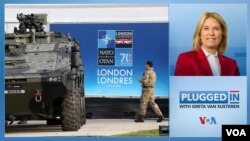
(OPENING TEASE)
On Plugged In…
A show of Unity…
At the NATO Summit In London…
Leaders of 29 member countries
Discussing emerging global security challenges…
And the future of the North Atlantic Treaty…
But amid the handshakes…
Nagging questions…
about America's commitment…
to Europe’s collective security.
(President Donald Trump)
“I got NATO to pay an extra hundred billion dollars they weren’t paying”
And the reliability of a US president…
under investigation at home.
Is NATO still necessary?
And is the principle of mutual defense…
still the best strategy for peace?
Plugged In looks at the future…
of the North Atlantic Treaty Organization
On “NATO at 70”
(WELCOME)
Hello and welcome to Plugged in.
I'm Mil Arcega, filling in for Greta Van Susteren.
The North Atlantic Treaty Organization - founded in 1949 after the second world war to provide mutual defense for member countries against the threat of communism - turned 70 this year.
29 nations make up the NATO alliance, soon to be 30 - with the addition of Macedonia.
But the anniversary got off to a difficult start this week as leaders of the United States, France and Turkey clashed over burden sharing and the future direction of the alliance.
VOA's London correspondent Henry Ridgwell has more.
(NATO TENSION TV REPORT)
NATO leaders attending a reception hosted by the Queen at Buckingham Palace – a cordial end to a fiery first day. Earlier, U.S. President Donald Trump and his French counterpart Emmanuel Macron clashed on the fate of foreign Islamic State fighters being held in Syria.
(President Donald Trump )
“Many are from France, many are from Germany and many are from UK. They're mostly from Europe. And some of the countries are agreeing. I have not spoken to the president about that. Would you like some nice ISIS fighters? I can give 'em to you. You can take everyone you want.”
(Emmanuel Macron, French President (in English) )
"Let's be serious. The very large number of fighters you have on the ground are fighters coming from Syria, from Iraq and the region."
(NARRATOR)
Macron said he stood by his comments that NATO is ‘brain dead’ – and reiterated criticism of Turkey.
(Emmanuel Macron, French President (in English) )
“When I look at Turkey, they now are fighting against those who fight with us, who fought with us, shoulder to shoulder against ISIS. And sometimes they work with ISIS forces.”
(NARRATOR)
Trump said pressure from the U.S. meant NATO members are now spending more on defense – and the alliance should tackle multiple threats.
(President Donald Trump )
“A lot of people say it was meant to look at originally the Soviet Union, now Russia. But we also have other things to look at, whether it's radical Islamic terrorism, whether it's the tremendous growth of China.”
(NARRATOR)
Tensions within NATO threaten to boil over. Last month Turkey ignored NATO objections and launched an offensive in northern Syria against Kurdish fighters.
On Tuesday, Turkish President Recep Tayyip Erdogan said he would oppose NATO’s plan to defend the Baltic states against Russia – unless the alliance recognizes those Kurdish fighters as terrorists.
Analysts say NATO is suffering from a clash of personalities.
(Kori Schake, International Institute for Strategic Studies)
“This summit has the ‘three presidents’ problem. President Trump, President Macron and President Erdogan. And the challenge for the institution is celebrating NATO’s 70th anniversary without one of those three presidents driving the whole thing off the rails.”
(NARRATOR)
Compounding NATO tensions, Turkey this year defied Washington by purchasing the Russian S-400 missile defense system – and recently tested it against its own American-made F-16 jets.
NATO’s Secretary-General insists the alliance is in good health.
(Jens Stoltenberg, NATO Secretary-General)
“We have just implemented the biggest reinforcements of our collective defense in a generation since the end of the Cold War.”
(NARRATOR)
Yet many delegates in London question whether the tensions are just a clash of personalities - or whether NATO has deeper problems.
(MIL ARCEGA)
So is it simply a clash of personalities and different agendas? Or are NATO's problems more structural in nature?
To help us out with that, we are joined by Henry Ridgwell - VOA's senior correspondent in London.
Welcome back to Plugged In Henry, that was a good report.
HR: Good to be with you Mil.
MA: It appears that clash between President Trump and the French president was maybe just the tip of the iceberg. It seems other world leaders, notably the Canadian prime Minister Justin Trudeau, was also caught on video talking about Mr. Trump behind his back. Has there been any reaction, has Mt Trump weighed in?
HR: He has indeed. You heard the three presidents’ problem mentioned in that report. President Trump, President Macron, and President Erdogan of Turkey. Now you can throw in a fourth, Prime Minister Trudeau, of Canada, who was caught on camera this morning at a gathering before the official summit, started telling an anecdote about Donald Trump. First of all he appeared to be talking or bemoaning the fact that Donald Trump was late because he had held an impromptu press conference. Then he told an anecdote which wasn't quite picked up by the microphones. And then he appeared to say that you could see Donald Trump's jaw, Donald Trump's team's jaws hit the floor when he made some announcement. It's not exactly clear what Justin Trudeau was talking about, but generally there was laughter. It appeared to be that Donald Trump was being made fun of. And Donald Trump has responded in the last couple of hours, he called, in a press conference, Justin Trudeau two-faced. And he said the reason why he may have made those comments is because that Canada has not been paying its two percent of GDP spending targets on defense. So, while NATO made an effort at the end there to have the handshakes to have the smiles for the 70th anniversary celebrations there's always something isn't there that can upset the cart.
MA: Isn't there. It seems to me a new low at least for leaders’ summit. But what appears clearer right now is that our U.N. allies appeared to be prepared in standing up to Mr. Trump. I'm wondering, what is the perception of Mr. Trump overseas? Are the impeachment hearings here in Washington affecting his credibility and perhaps his influence among leaders there at the UN summit?
HR:
I think leaders certainly here in London at a NATO meeting are being very cautious.
MA: Sorry I meant NATO Summit.
HR: Sorry, just saying I think the leaders here in London at the NATO meeting are being very cautious about that. It's certainly bad form to talk about the domestic problems of a president particularly when he's not on his home territory. But also I think they are following the impeachment hearings very closely and also the lead up to the 2020 presidential election. And it's clear that it's quite possible that the other leaders in NATO could be dealing possibly with another four years of a President Trump in the White House. So, nobody wants to burn any bridges here, but it's clear that something has been caught off mic here that may have caused a minor incident in NATO. We await to see what Donald Trump's reaction will be when he gets back to Washington later tonight. Everybody, I guess, will have their eyes on Twitter.
MA: Yeah, for sure. We will be too. But last question for you, Henry. Mr. Trump seems to be showing a lot more deference to Turkey's president, Erdoğan. Does that tell you a little bit about… does that give us any clues about some of the tensions surrounding this summit?
HR: It does. President Trump had a bilateral meeting with President Erdoğan on this afternoon and he was asked specifically about what was talked about there. President Trump praised the Turks for securing that border with Syria. He said that the withdrawal of American troops from northern Syria had been a success and that it was time that those troops came home and that they owed their own countries troops patrolled that border. So that would seem to be a rejection of French President Emmanuel Macron’s criticism of the Turkish role in northern Syria and their targeting of Kurdish troops there. Don't forget many of these Kurdish fighters fought alongside Western coalition troops to take on Islamic State. So, there does certainly seem to be some differences of opinion over Turkey's role in NATO. I think where President Trump has held common ground, even with President Macron at this summit, is on Turkey's purchase of a Russian made missile defense system the S-400 which it has tested against American made F16 jets. And that for a NATO member to be buying Russian military equipment really has caused many problems here at the summit. But that isn't the only problem. I think the last thing to say about this summit though is that many people have praised the Secretary General, Jens Stoltenberg, for holding together all of these 29 leaders despite all of those differences. And his points at the end was that while the disagreements will always make greater news, because we live in free democratic societies and that's what NATO is here to defend.
MA: Thank you for your reporting. Henry Ridgwell. Our VOA correspondent in London.
(MIL ARCEGA)
With the growing threat of terrorism and another Cold War looming, is NATO ready to respond if needed? And does NATO have the full support of its most important member, the United States?
VOA's White House Correspondent Patsy Widakuswara is covering the US president and filed this report from the NATO summit in London.
(TV REPORT)
Fighting continued in Northeastern Syria following Turkey’s invasion of Kurdish-held territory. President Donald Trump ordered American forces to leave in October, without consulting NATO allies.
(Gary Schmitt, American Enterprise Institute)
“It's exactly in the wake of that decision that you had President Macron say what he said about the alliance being “brain-dead” and referencing the lack of American leadership in the sense of leading in a community and not just going out on your own.”
((NARRATOR))
Meanwhile, a simmering war between Russia and Ukraine has become the backdrop of Trump’s impeachment.
(gunfire)
The two conflicts in Europe's eastern and southern flank, further complicates Washington’s already strained relations with other NATO members.
Donald Trump no longer publicly says that the alliance is obsolete and wants to leave it, but continues to slam member countries for not meeting NATO’s 2% GDP defense spending target.
American officials have reassured European leaders of Washington’s continued commitment, as shown by military reinforcement in NATO’s eastern flank. But anxiety persists that under Trump, the US is rejecting the alliance.
(Hans Kundnani, Chatham House)
“Some of them are hoping that Trump will be out of office in a year's time. But the real fear is that Trump wins a second term.”
(NARRATOR)
Across Europe responses differ. Paris is touting “strategic autonomy” – that Europe should take care of their own security. Warsaw is promoting “strategic embrace” – developing close bilateral relationship with Trump to guarantee its own security.
(Hans Kundnani, Chatham House)
“And then you have Germany in the middle, which is a little bit divided between the “Atlanticists” on the one hand, who do believe in NATO and believe that NATO continues to be how the security of Europe should be guaranteed. And then on the other hand, the “post-Atlanticist” – a sort of more on the French side of this argument. So, Europeans are very much arguing about that.”
(NARRATOR)
Just days before the summit, NATO announced it had agreed to redistribute costs and reduce Washington’s contribution to its relatively small central budget, a move aimed at placating Trump.
(MIL ARCEGA)
And for more on the issues and the back stories surrounding this historic summit we caught up with VOA's White House correspondent Patsy Widakuswara on assignment there in London.
I spoke with her earlier about whether the impeachment hearings in Washington have overshadowed President Trump's meetings with world leaders. She also discussed the various security and economic issues that each leader brings to the table..
(Patsy Widakuswara Interview)
PW: So for European leaders the issues the big issues include terrorism, particularly the potential resurgence of ISIS after the withdrawal of American forces from north eastern Syria. In October, which President Trump did without consulting NATO allies, as well as the fear or the concerns over Russia, not just Russian expansionism as what they've done in Crimea, but also the Russian election meddling which is a big issue here in the UK as they head into their elections on December, 12. Now those are European concerns but for President Trump and the US, the big issues include China and trying to pressure European allies, not to include China in the building of their 5G networks, as well as continuing the pressure on Iran. As we know there are nine European countries so far, who have joined INSTEX. This is a system, a mechanism, a barter mechanism that's designed specifically to circumvent US sanctions as it avoids the use of the dollar. And the other big issue of course Mil, is burden sharing. This is something that President Trump has continuously pressured European leaders to fulfill the 2% target of GDP for defense spending for NATO. Currently only nine of the member countries nine out of the 29 member countries have met or exceeded this target.
MA: And all this happening at a very complicated time for the President of the United States. He’s being challenged at home with the prospect of impeachment, his credibility in question in Europe…
PW: So on the issue of impeachment I think out of politeness, European leaders NATO leaders are largely avoiding that question at least publicly for President Trump, and I should note that President Trump is not the first US president who comes into a NATO Summit, under the cloud of impeachment. In 1974 Richard Nixon on the 25th anniversary of NATO also came to a NATO Summit. This was in June and then several weeks later he was of course removed from office or he resigned from office. So I think perhaps the similarities there are that both presidents come, perhaps a little bit distracted with these domestic pressures from home, but both tried to project a sense of normalcy.
In terms of how European leaders are facing President Trump after his third year in office I think the views are quite divergent across Europe. In Paris you have Macron who is advocating the strategic autonomy view that Europe must take care of its own security and not rely so much on the US. Meanwhile from Poland president Duda we know very much linked closely aligned to President Trump and he's advocating what's called a strategic embrace. Meanwhile, Germany is somewhat in the middle advocating a strategic patience, a kind of wait and see approach to see whether or not President Trump will become re-elected and this is of course another fear in Europe, as they see the US gradually withdrawing from its commitment to Europe, there is a sense of crisis that if President Trump gets reelected, then the withdrawal of the US commitment from Europe will become more cemented.
MA: Does the president still believe that NATO is not quite as effective as it should be and why?
PW: He has not publicly said that NATO is obsolete. But he still often complains about inequitable burden sharing, particularly during the his rallies. This has has become like a familiar theme for President Trump. So going ahead, this is something that NATO as an alliance will have to deal with, how to stay relevant and how to stay effective in the midst of all these internal and external challenges. And for this purpose, there is a German and Franco proposal to put together a group of what they call respected figures of experts to discuss and advise NATO on what can be done in the future to guarantee the longevity and also relevance of this alliance.
MA: Patsy, NATO represents a safety net for about a billion people around the world. Is it still an effective safety net against outside hostile forces?
PW: Well yes that's something that NATO really wish to project in the future is this idea of military coherence, despite their internal political threat I mean it's still the most well organized most well funded and the most, basically, most militarized pact or treaty or alliance in the world. So, in terms of military coherence, if they can go forward and prove that they can, you know, overcome their own internal strife, this is certainly a force that should still be reckoned with.
MA: And that was VOA White House Correspondent, Patsy Widakuswara.
(MIL ARCEGA)
Well, affter this NATO Summit, the leaders of Russia and Ukraine will meet face-to-face for the first time in Paris. Germany's Angela Merkel and France's Emmanuel Macron will be there as well.
Ukraine is not a NATO member but it is pivotal to NATO's security interests because of its location as a buffer of sorts between NATO and Russia. But it is a buffer that has been at war with Russian-backed rebels for the last five years. Charles Maynes explains from Moscow.
(TV Report)
(machine gun fire)
For 5 years, Ukraine’s government has been locked in grinding battle with pro-Russian separatists in eastern Ukraine’s Donbas region…with more than 13,000 killed.
Over that period, the Kremlin has maintained it’s not part of a war in which Russian soldiers, rebranded as “volunteers.” have joined in the fighting while European powers have repeatedly tried — and failed— to negotiate an end to the violence.
Against that backdrop, enters a newcomer: Volodymyr Zelenskiy. A comedic actor made famous for a role playing an accidental Ukrainian president on TV, Zelenskiy won the real thing in a landslide election victory earlier this year.
His central promise to voters: to end the war in east Ukraine. Russian analysts say the Kremlin has taken note.
(ANDREY KORTUNOV, DIRECTOR, RUSSIAN INTERNATIONAL AFFAIRS COUNCIL)
“He promised peace. That was one of the most important points of his election campaign and he tries to deliver. So we see a new flexibility on the Ukrainian side which allowed to reach a couple of agreements on specific issues.”
(NARRATOR)
Successes include a mass prisoner exchange that took place this past September…
And then last month Russia returned three Ukrainian naval ships it had seized a year prior — a gesture that turned sour after Kyiv accused Moscow of stripping the vessels into disrepair.
Still, Russian polls indicate a ‘Zelenskiy effect’ — as Russian attitudes hardened by state propaganda demonizing Ukraine have begun to soften.
(SERGEI and KAROLINA)
SERGEI: “He’s just a popular figure here in Russia…He played in those television games in Moscow some years ago. His image is better as opposing to the previous president.”
KAROLINA: "He sure is, yes yes….”
SERGEI: “More friendly, more open…”
(BORIS KAGARLITSKY, PROFESSOR, MOSCOW HIGHER SCHOOL FOR SOCIAL AND ECONOMIC SCIENCES) “There are millions of people in Russia who saw these performances and movies who laughed at his jokes. He’s funny! And an enemy shouldn’t be funny. Any enemy should be frightening. An enemy should be scary. Zelenskiy’s not.”
(NARRATOR)
But the laughs don’t extend to the Donbas — with Ukraine still looking to regain control over territory lost to pro-Russian rebels and Russia insisting on special status for — and perhaps influence over — ‘independent republics’ not even Moscow recognizes.
Meanwhile, Zelenskiy, faces other political challenges: His efforts to make peace with Moscow have alienated militant forces at home, while his cameo role in the impeachment hearings in Washington has put US support for Ukraine in question just when Zelenskiy needs it most.
Given the complexities, both sides are hinting an agreement to deliver Russian oil and gas through Ukraine to Europe may prove the easiest deliverable for these Paris ‘peace talks.’
It’s a small but important step towards rebuilding trust… and a tacit acknowledgement that Ukraine and Russia remain locked as neighbors…whether they like it or not. Charles maynes for VOA News, Moscow
(MIL ARCEGA)
So Why does Ukraine matter? And are NATO leaders closer to solving the Russia Ukraine imbroglio?
What are the current threats, challenges - facing NATO as the alliance celebrates its 70-year anniversary?
Joining us now to share her insight and her expertise is Heather Conley.
Ms. Conley is senior vice president at the Center for Strategic & International Studies in Washington,
where she heads the Europe and Eurasia program.
She also served in the US State Department as a deputy assistant secretary of state for European and Eurasian Affairs. And she was formerly executive director at the American Red Cross.
MA: Thank you so much for joining us Ms. Conley.
HC: Great to be here.
MA: Ms. Conley, how central is this whole Ukraine conundrum to the security of NATO member countries?
HC: So in many ways NATO security begins in Ukraine and it's really been Russia's illegal annexation of Crimea and its military incursions into eastern Ukraine in 2014 that really transformed NATO. And the summit that the alliance held in Wales And 2014 was the summit that repositioned NATO reinforced NATO's eastern flank and placing four NATO battalions in the three Baltic states and Poland as well as reinforcements in southern Europe. It was transformative for Europe to spend more on its own defense.
And what we saw today in the declaration that came from the later the London leaders meeting was in fact again a reaffirmation that one of NATO's most important purposes is to protect NATO members from potential Russian aggression. I do have to say Ukraine has been an extraordinary laboratory for Russian hybrid tactics. And these are tactics that the US and other NATO allies are studying are trying to understand. And of course build resilience toward and of course defer further types of these hybrid activities. But it's extremely important. And I think some ways the impeachment inquiry here in the United States has has diminished Ukraine's strategic importance to NATO to Europe to the United States.
MA: So we're hearing a lot of affirmation from the from NATO leaders. But are we going to see any results as a result of this summit meeting and I'm wondering, I mean, how does, how is Vladimir Putin seeing all of this as it's going on in London?
HC: What is very difficult and what your what you’re seeing, I like to divide it into two: what you see is the noise and then there's the work. So I’m going to focus on the work and then I'll talk a little bit about the noise. The work is really found, and again this was a meeting. It wasn't a formal summit. This was an opportunity for the leaders to gather to commemorate 70 years of NATO, which in itself is a historic accomplishment.
But really it's about the alliance looking towards its next 70 years. So this declaration focuses on the fact that NATO members have now substantially increased their defense spending. And President Trump highlighted this in fact before he left for this trip and on the trip. So NATO is making important headway to strengthen its own defense. The alliance talked about future challenges, emerging technologies, 5G artificial intelligence and of course that is connected to the challenge that China is posing towards Europe and the United States. And understanding those challenges NATO has now adopted space as a new domain that it needs to consider in light of deterrence and defense. NATO is about to formally welcome its 30th member North Macedonia. One more country, Spain has yet to ratify that because they haven't had a government in the last year. That will happen. So NATO is strong. It's looking towards the future. That's the work. That's the good part. Needs to do more, needs to keep going faster but that's a good part. The noise that we've heard over the last several days is about leaders having very public conversations about threats about disagreements. You saw that with President Trump's press conference with President Macron. This is how NATO works through its political alliance and it can be very messy and it can be very public. But that's actually an enduring strength.
So yes, there are big disagreements but this is how the alliance works through them and I think the message to the Kremlin is - we have dynamic conversations but at the end of the day we are a strong alliance.
MA: There's also a lot of grumblings about Turkey's role in NATO. It appears there’s a lot of people, leaders who think that perhaps Turkey does not entirely belong within that membership simply because of its closeness with Russia. How difficult is that conundrum, the Turkish problem.
HC: So in some ways Turkey again going back into NATO's rich history, Turkey has always been a challenging ally to NATO. Of course it was so important when it was brought into NATO in 1952.
It was because both Greece and Turkey were under enormous strain because of Soviet influence and interference. And now as we see Turkey rethinking quite frankly its position regionally I think it views itself much more as a Middle East and Eurasian power than it does a euro-Atlantic power. And you're absolutely right, growing Turkish Russian relations, whether that's Turkey's purchase of the S-400 missile defense system in defiance of both the US and of NATO, this will diminish. The closer that Turkey gets to Russia, it will diminish NATO's capabilities and opportunities for NATO to protect Turkey. This was one of the most divisive subjects with President Macron and it continues to be a very divisive issue with the U.S. Congress. So you're absolutely right. This has been tough historically but NATO has always worked through those challenges. And in fact we saw them work through those challenges today.
MA: So Ms. Conley, what is your assessment (coughs), I'm sorry, what is your assessment of this year's NATO summit. Are they prepared, is NATO prepared for the next 70.
HC: So again this leaders meeting demonstrates both the durability of this alliance and its military contributions. It also points to the Trans-Atlantic conversations that this alliance has had for the last 70 years. Some of them have been incredibly tough and they're going to be 70 more years of incredibly tough political conversations. But at the end of the day this alliance is now nearly at 30 members.
It's just spending over 130 billion in defense dollars. This is a strong alliance. The politics are shaking, no doubt about it. But it remains strong and quite durable, and I think it transcends any one individual NATO leader.
MA: That is very good to hear. Thank you so much. Ms. Heather Conley director of the European Affairs Program at CSIS, the Center for Strategic and International Studies.
(MIL ARCEGA)
Before we go, here's a name you may not have heard in some time -- Lech Walesa.
He is the Polish electrician who organized his shipyard co-workers and led the Solidarity trade union movement ---one of the forces that led to the fall of the Soviet Union.
Walesa won the Nobel Peace Prize and eventually became Poland's first president elected by popular vote. Now while the threats facing the world may be different today, Walesa says not only is NATO's presence in the world necessary - it must evolve to deal with the geopolitical complexities of today and the future.
(LECH WALESA, FORMER POLISH PRESIDENT) (Polish Translated to English)
“Forces like NATO will be needed, are needed today and will be needed in the future. We have created so many potential dangers with our new technologies, some chemicals, that new, unexpected disasters may occur and forces like NATO will be needed to react to those.”
And we leave you with that thought.
That’s all the time we have.
Thanks for watching Plugged In.