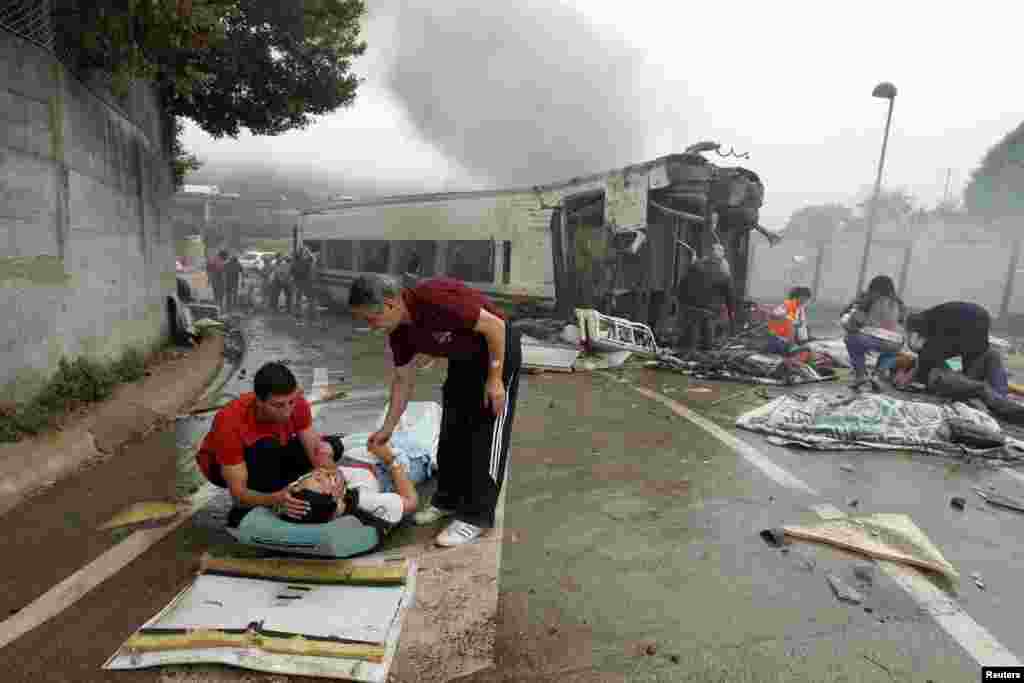
An injured man, identified by Spanish newspapers El Pais and El Mundo as the train driver Francisco Jose Garzon, is helped by a policeman after a train crashed near Santiago de Compostela, northwestern Spain, July 24, 2013.
MONFORTE DE LEMOS —
Francisco Garzon, driver of the train that crashed at high speed in one of Spain's worst railway accidents, grew up around trains and spent his whole life working with them.
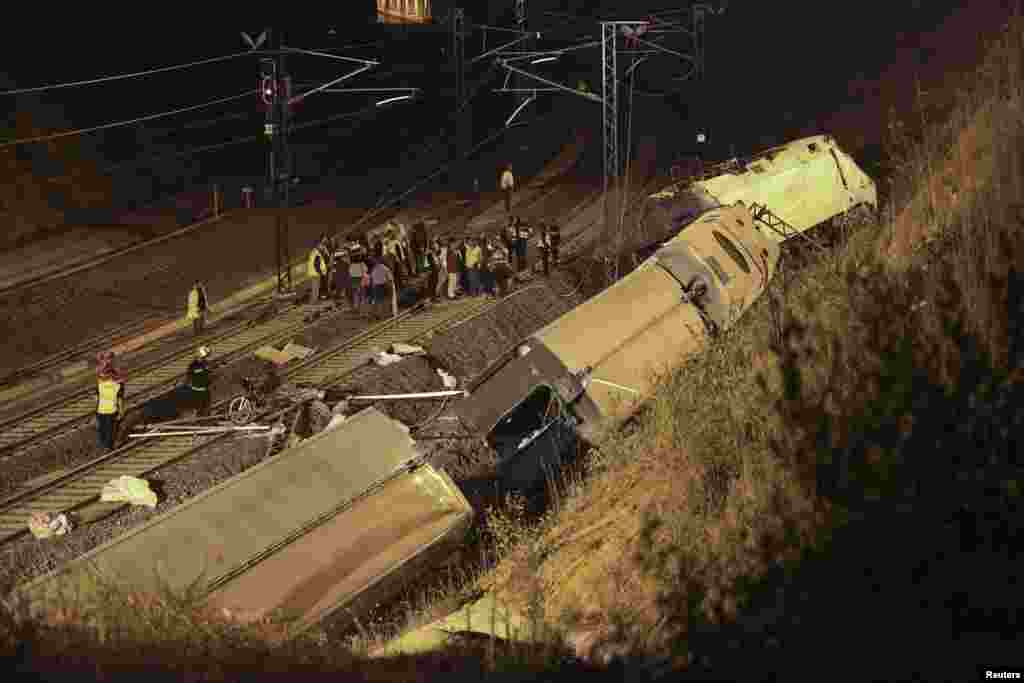
At least 78 people died after the train jackknifed into a concrete wall on Wednesday a few kilometers before the station in Santiago de Compostela, a pilgrim destination and capital of the northwestern region of Galicia.
Garzon, who walked away bleeding heavily from a gash to the head, survived. In shock and using an expletive, the seasoned driver hoped for no deaths and feared for his conscience.
Son of a railway worker, Garzon grew up in a small Galician town known as the cradle of the region's rail industry. He lived in housing built for railway workers and went to a school run by state train firm Renfe.
In his hometown of Monforte de Lemos, people said the 52-year-old who has worked three decades with Renfe, and more than 10 as a driver, was known for being sensible and reliable.
They were asking why a highly qualified driver with his work history would have taken a sharp curve at over twice the speed limit, derailing the train shortly after taking the controls.
“He was a great guy, one of the best,” said Maria Montero, standing at the door of one of the Renfe-owned workers' cottages where Garzon grew up. She had known Garzon since he was a child.
“He was sensible and very good at his job, we don't know what could have happened. He was very competent,” said Julia Morais, 52, walking alongside the railway track with her mother.
Investigations into the cause of the accident focused on why this experienced driver did not slow down as he entered the known danger spot on the outskirts of Santiago.
Train Accident in Spain Kills Dozens
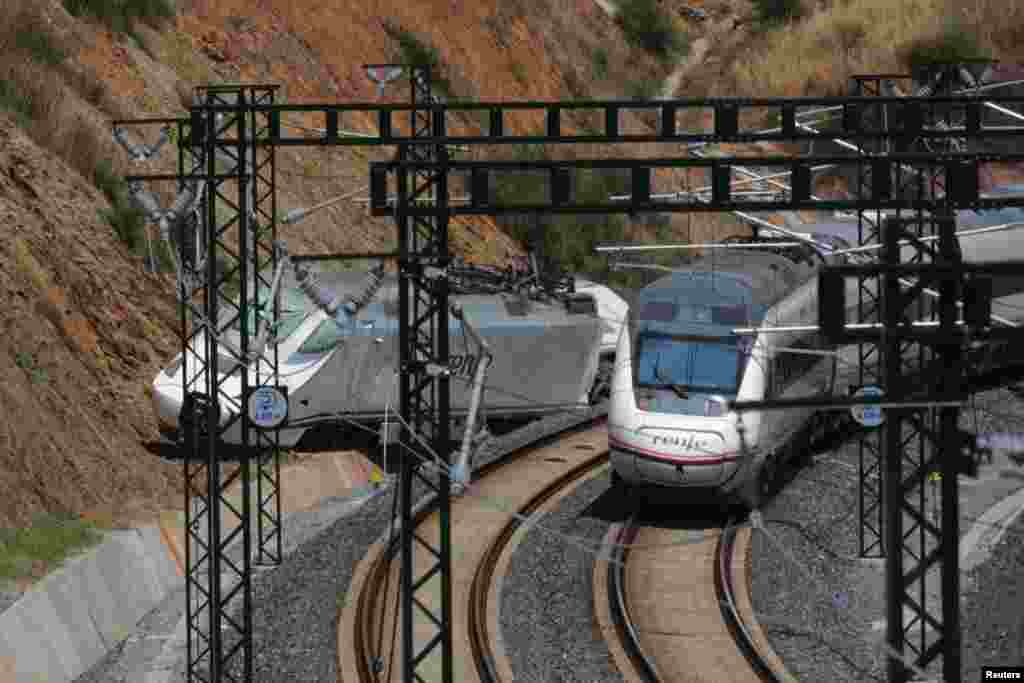
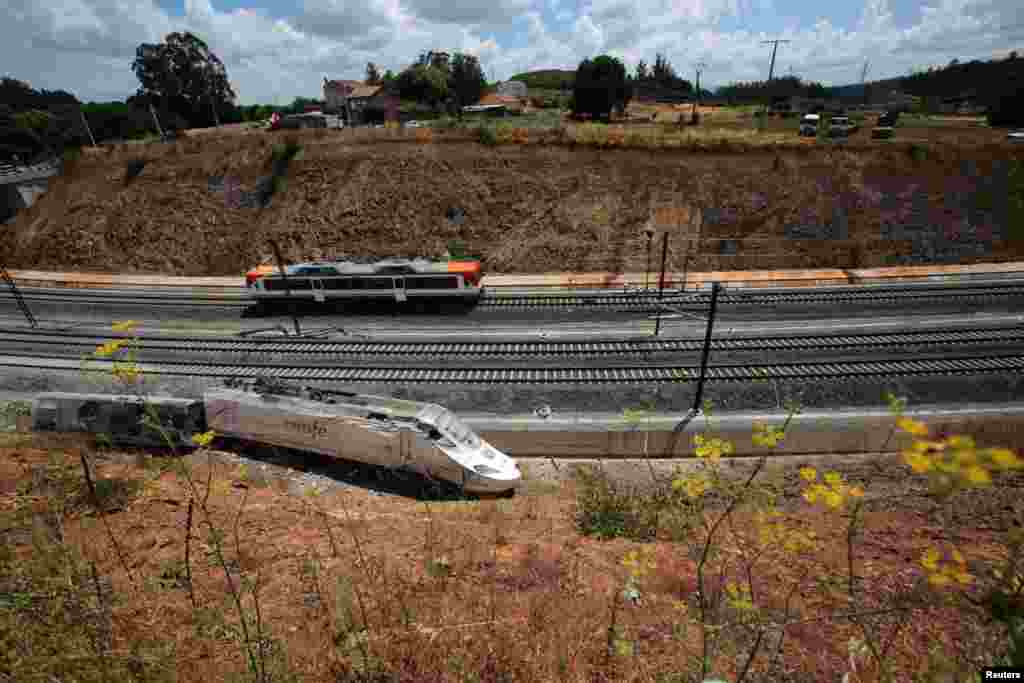
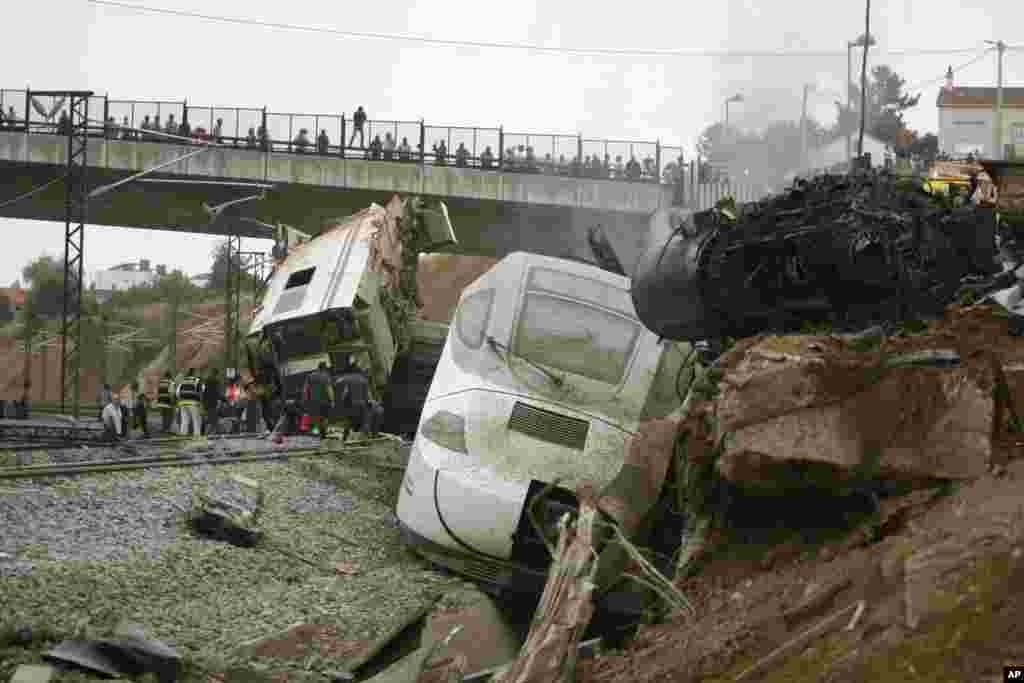
1/15A passenger train passes by a wrecked train engine at the site of the train crash in Santiago de Compostela, northwestern Spain, July 26, 2013.
An investigation is under way into one of Europe's worst rail disasters following a train crash in Spain's Galicia region. At least 78 people died after the train jackknifed into a concrete wall a few kilometers before the station in Santiago de Compostela.
Show moreShow less
2/15Groom Mahmoud Mansour, 26, and his bride Maral Malka, 23, celebrate with friends and family before their wedding in Mahmoud's family house in Jaffa, south of Tel Aviv, Aug. 17, 2014.
An investigation is under way into one of Europe's worst rail disasters following a train crash in Spain's Galicia region. At least 78 people died after the train jackknifed into a concrete wall a few kilometers before the station in Santiago de Compostela.
Show moreShow less
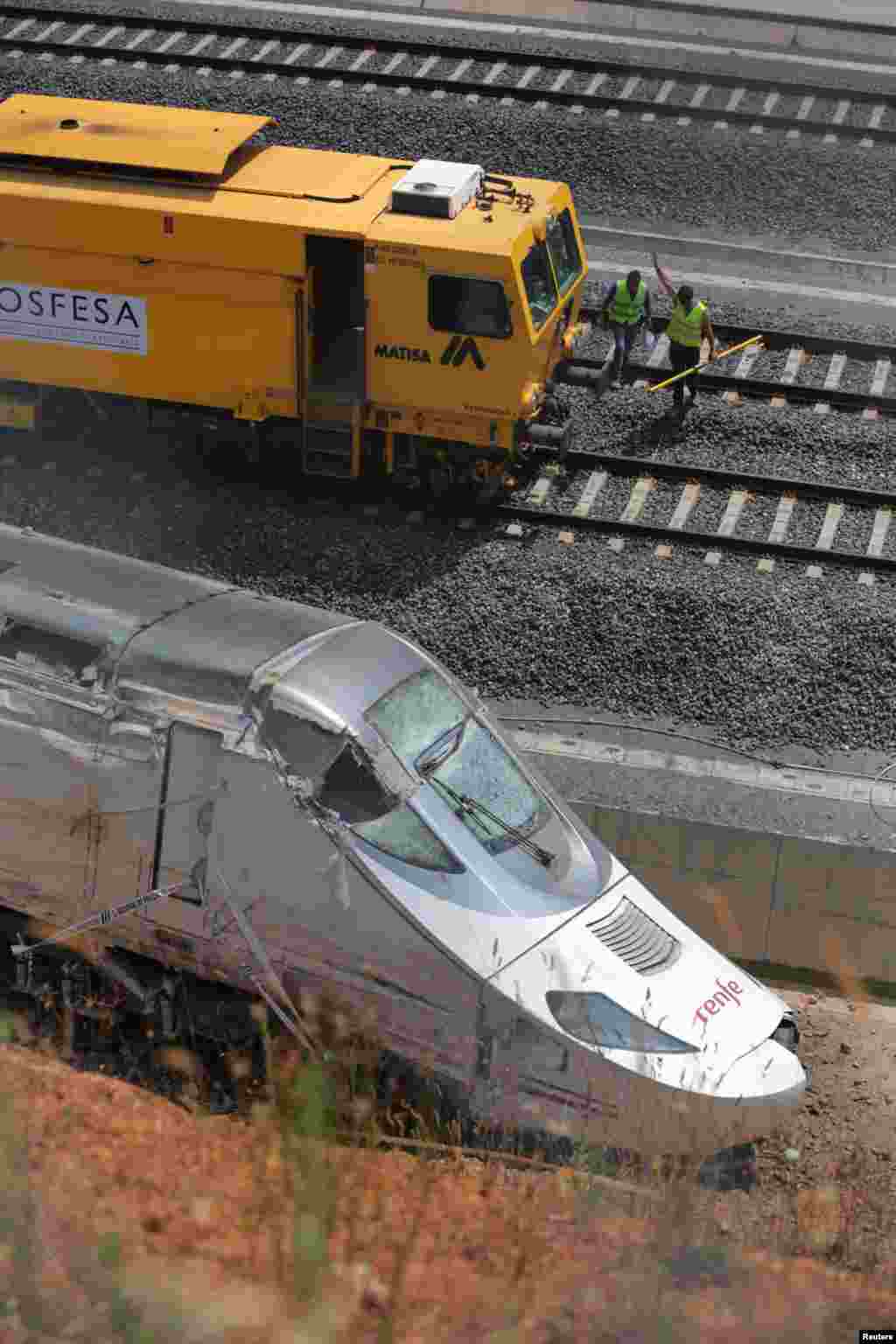
3/15Rail workers clear the tracks next to a wrecked train engine at the site of the train crash in Santiago de Compostela, northwestern Spain, July 26, 2013.
An investigation is under way into one of Europe's worst rail disasters following a train crash in Spain's Galicia region. At least 78 people died after the train jackknifed into a concrete wall a few kilometers before the station in Santiago de Compostela.
Show moreShow less
4/15A passenger train passes by a wrecked train engine at the site of the train crash in Santiago de Compostela, northwestern Spain, July 26, 2013.
An investigation is under way into one of Europe's worst rail disasters following a train crash in Spain's Galicia region. At least 78 people died after the train jackknifed into a concrete wall a few kilometers before the station in Santiago de Compostela.
Show moreShow less
5/15A crane removes a carriage from the tracks at the site of a train crash near Santiago de Compostela, northwestern Spain, July 25, 2013.
An investigation is under way into one of Europe's worst rail disasters following a train crash in Spain's Galicia region. At least 78 people died after the train jackknifed into a concrete wall a few kilometers before the station in Santiago de Compostela.
Show moreShow less
6/15A relative of one of the victims of the train crash reacts in Santiago de Compostela, northwestern Spain, July 25, 2013.
An investigation is under way into one of Europe's worst rail disasters following a train crash in Spain's Galicia region. At least 78 people died after the train jackknifed into a concrete wall a few kilometers before the station in Santiago de Compostela.
Show moreShow less
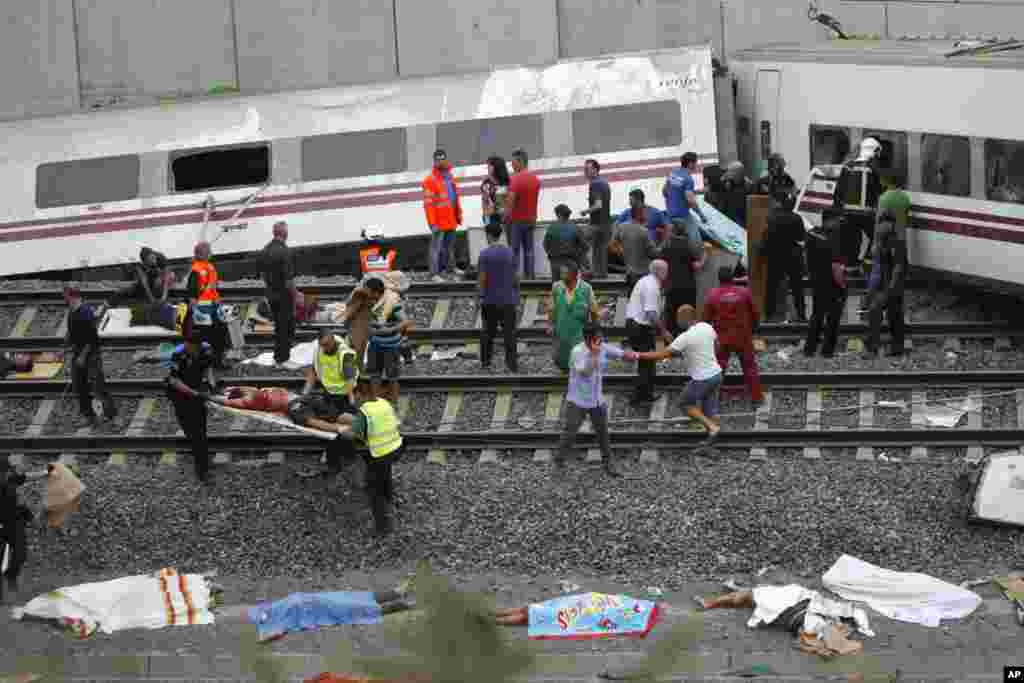
7/15Victims receive help after a train crashed near Santiago de Compostela, northwestern Spain, July 24, 2013.
An investigation is under way into one of Europe's worst rail disasters following a train crash in Spain's Galicia region. At least 78 people died after the train jackknifed into a concrete wall a few kilometers before the station in Santiago de Compostela.
Show moreShow less
8/15Rescue workers pull victims from a train crash near Santiago de Compostela, northwestern Spain, July 24, 2013.
An investigation is under way into one of Europe's worst rail disasters following a train crash in Spain's Galicia region. At least 78 people died after the train jackknifed into a concrete wall a few kilometers before the station in Santiago de Compostela.
Show moreShow less
9/15Emergency personnel respond to a train derailment in Santiago de Compostela, Spain, July 24, 2013.
An investigation is under way into one of Europe's worst rail disasters following a train crash in Spain's Galicia region. At least 78 people died after the train jackknifed into a concrete wall a few kilometers before the station in Santiago de Compostela.
Show moreShow less
10/15Emergency personnel treat survivors after a train derailment in Santiago de Compostela, Spain, July 24, 2013.
An investigation is under way into one of Europe's worst rail disasters following a train crash in Spain's Galicia region. At least 78 people died after the train jackknifed into a concrete wall a few kilometers before the station in Santiago de Compostela.
Show moreShow less
11/15Emergency personnel respond to a train derailment in Santiago de Compostela, Spain, July 24, 2013.
An investigation is under way into one of Europe's worst rail disasters following a train crash in Spain's Galicia region. At least 78 people died after the train jackknifed into a concrete wall a few kilometers before the station in Santiago de Compostela.
Show moreShow less
12/15Місто Фергюсон.
Багато американців обурились тим, як поліція міста повелась у перші дні протестів. Проти мітингувальників виставили мілітаризовані підрозділи поліції, а до журналістів застосували силу.
An investigation is under way into one of Europe's worst rail disasters following a train crash in Spain's Galicia region. At least 78 people died after the train jackknifed into a concrete wall a few kilometers before the station in Santiago de Compostela.
Show moreShow less
13/15Rescue workers pull victims from a train crash near Santiago de Compostela, Spain, July 24, 2013.
An investigation is under way into one of Europe's worst rail disasters following a train crash in Spain's Galicia region. At least 78 people died after the train jackknifed into a concrete wall a few kilometers before the station in Santiago de Compostela.
Show moreShow less
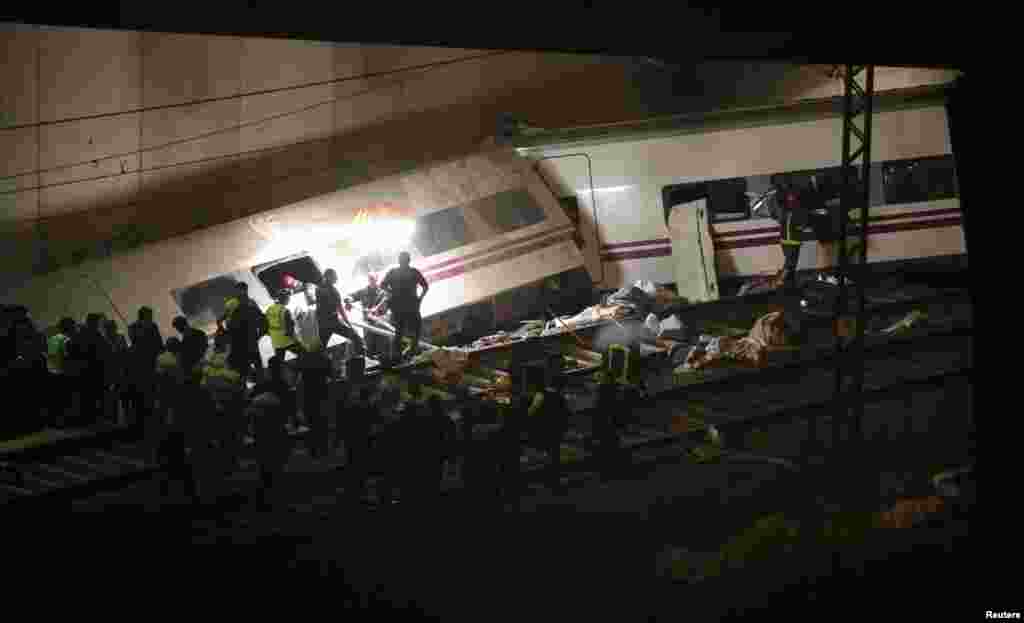
14/15Rescue workers and officials are seen amongst the wreckage of the train crash near Santiago de Compostela, northwestern Spain, early July 25, 2013.
An investigation is under way into one of Europe's worst rail disasters following a train crash in Spain's Galicia region. At least 78 people died after the train jackknifed into a concrete wall a few kilometers before the station in Santiago de Compostela.
Show moreShow less
15/15Relatives of the victims involved in the train accident react at a victims' information point in Santiago de Compostela, Spain, July 25, 2013.
An investigation is under way into one of Europe's worst rail disasters following a train crash in Spain's Galicia region. At least 78 people died after the train jackknifed into a concrete wall a few kilometers before the station in Santiago de Compostela.
Show moreShow less
Previous slide
Next slide
Sharp bend
The bend is on a part of the railway that changes from a high-speed track to a traditional track and drivers must slow the train down because there is no automatic braking system.
Garzon was under police arrest in hospital and police said they would question him as soon as he was well enough to give a statement. He suffered minor injuries in the crash and his mother spent the night with him in the hospital, press reports said.
A judge has opened an official investigation into the accident and police said at a news conference on Friday that Garzon is suspected of recklessness in the accident. But the judge has not formally charged him with a crime.
The driver was not available for comment and Reuters was not able to locate his family or determine whether he has a lawyer.
Garzon took control of the Madrid-Ferrol train from his colleague at the Ourense station, one stop before Santiago de Compostela, Renfe said, a common practice on long-haul journeys. He knew the line well, having driven it for a year.
The other driver then left the cabin to rest, as normal, Renfe said. Earlier in the day, Garzon had driven part of the outward journey from the Galician city of La Coruna to Madrid.
Security camera footage showed the train about 40 minutes after it left Ourense station traveling at high speed around the bend, flying off the track and crashing into a wall.
Just after the crash, Garzon spoke over the train's radio system to the railway control center and to emergency services.
In one of the conversations he said the train was going at 190 km per hour (120 mph) into the curve, where the speed limit is 80 km/h, according to transcripts published in local media.
Train driver Francisco Jose Garzon (R) is helped by two men after his train crashed near Santiago de Compostela, northwestern Spain, July 24, 2013.
Covered in blood
Pictures show the gray-haired, slight driver speaking into a mobile phone, his face covered in blood.
“I hope there are no dead, because this will weigh on my conscience,” Garzon said in one of the conversations, according to media reports of the transcripts.
In the past, Garzon posted entries on Facebook boasting of driving trains at high speeds but within the legal limit, said a source with knowledge of the matter. In one post he displayed a photograph of the train's speedometer at 200 km/h.
These boasts were common among train drivers, and that speed was normal for the type of train Garzon drove, the source said.
Garzon was driving a hybrid train on Spain's Alvia high-speed service that travels at a maximum of 250 km/h. The even faster AVE service runs trains that can travel upwards of 300 km/h.
In Monforte de Lemos, an industrial town of 20,000 with a railway heritage dating back to the 19th century, villagers spoke highly of the driver who was separated with no children.
They said he had started working for Renfe at a very young age, fuelling trains.
Garzon lived in the Galician city of La Coruna with his widowed mother who lost her other son, Garzon's brother, in a car accident, villagers said. But he maintained a flat in Monforte and often visited friends there.
“He was very kind, a good friend,” said Monforte newspaper stand owner Concepcion Rodriguez who had seen Garzon the day before the accident.
Reuters is a news agency founded in 1851 and owned by the Thomson Reuters Corporation based in Toronto, Canada. One of the world's largest wire services, it provides financial news as well as international coverage in over 16 languages to more than 1000 newspapers and 750 broadcasters around the globe.