Thailand’s Embattled Prime Minister Insists She Will Stay
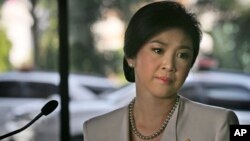
Thailand's Prime Minister Yingluck Shinawatra gets emotional after speaking at a press conference, in Bangkok, Thailand, Dec. 10, 2013.
BANGKOK —
Thailand’s government is again rebuffing demands from protest leaders that it be dissolved to make way for an appointed council to lead the country.
A day after she moved to dissolve the parliament and call for elections, it became evident that weeks of street protests against her government were taking an emotional toll on prime minister Yingluck Shinawatra.
In brief remarks, she pleaded for understanding that she must remain as caretaker until elections on February 2, despite repeated demands by the opposition for her to immediately depart.
The prime minister said she has backed down to the point where she does not know how to concede any further. She said she also wants to be treated fairly.
As she left the podium, reporters noticed her eyes welling with tears.
Outside the Army Club where she was meeting with members of her cabinet, demonstrators pressed for her removal.
The previous day more than 150,000 people had marched to the main government complex in opposition to what they label an illegitimate regime controlled by Yingluck’s brother - former prime minister Thaksin Shinawatra. He remains in self-imposed exile to avoid prison time for a corruption conviction in Thailand.
Protests in Bangkok
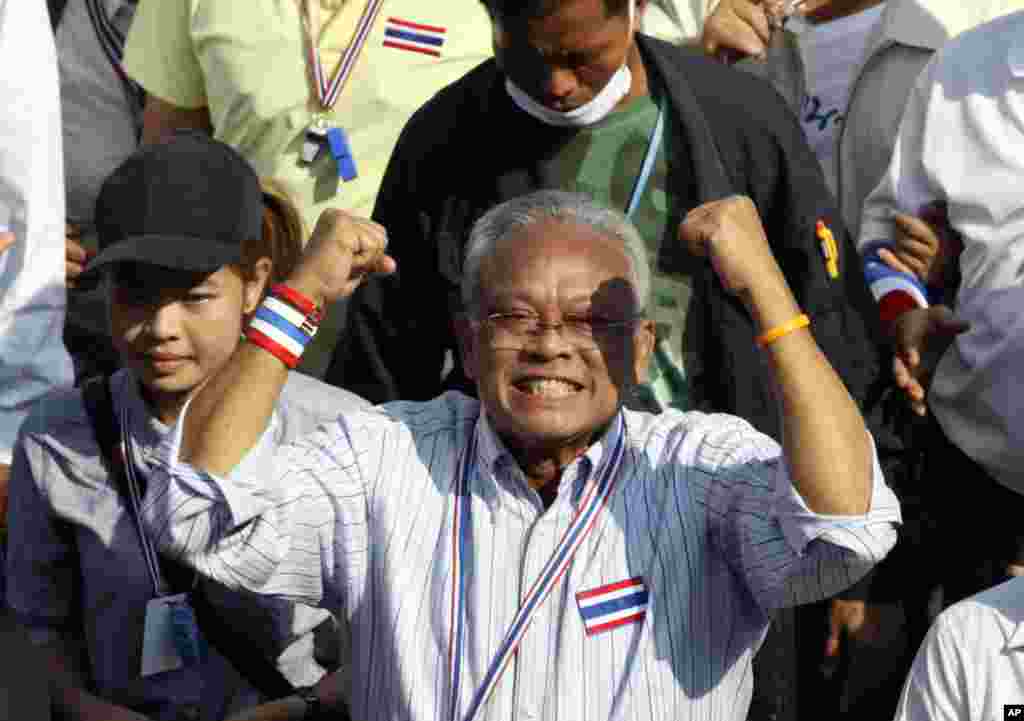
1/12Thai anti-government protest leader Suthep Thaugsuban holds clenched fists during a march with his supporters in Bangkok, Thailand, Dec. 22, 2013.
Show moreShow less
2/12Thai anti-government protesters march cross Takin Bridge during a rally, Dec. 22, 2013, in Bangkok, Thailand.
Show moreShow less
3/12Thai anti-government protesters march in the streets, Dec. 22, 2013, in Bangkok, Thailand.
Show moreShow less
4/12Tens of thousands of protesters marched through Thailand's capital paralyzing traffic and facing off with police outside the prime minister's residence in their latest mass rally against Thailand's government, Dec. 22, 2013, Bangkok, Thailand.
Show moreShow less
5/12A Thai anti-government protester holds a banner as she joins a rally outside Prime Minister Yingluck Shinawatra's residence, Dec. 22, 2013, Bangkok, Thailand.
Show moreShow less
6/12Anti-government protest leader Suthep Thaugsuban, center, with his wife Srisakul Promphan, in white, arrives at the Democracy monument, in Bangkok, Thailand, Dec. 15, 2013.
Show moreShow less
7/12A protester with a Thai national flag walks past concrete barriers sprayed with "Failed Government" outside the fence around Government House, wrapped by a long banner in the colors of the national flag in Bangkok, Dec. 13, 2013.
Show moreShow less
8/12Anti-government protesters remove barbed wire after briefly entering the compound of the prime minister's office, known as Government House, in Bangkok, Dec. 12, 2013.
Show moreShow less
9/12Police wear their riot gear inside Government House, as anti-government protesters gather behind its fence and gates in Bangkok, Dec. 12, 2013.
Show moreShow less
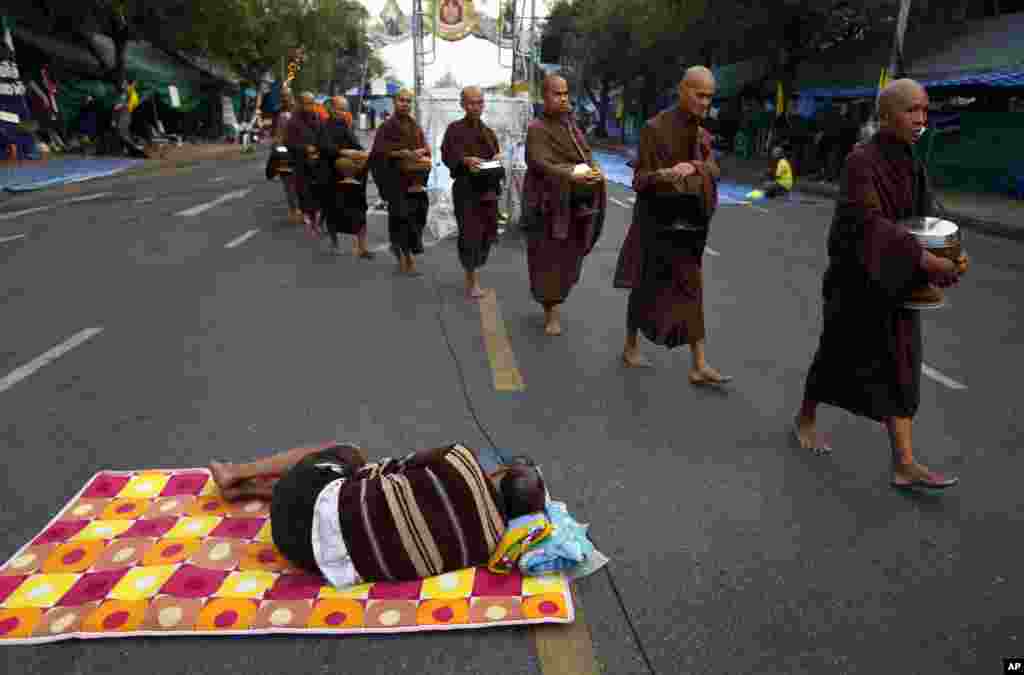
10/12A group of Buddhist monks walk past a sleeping anti-government protester at a protest camp on a road near Government House in Bangkok, Dec. 11, 2013.
Show moreShow less
11/12Anti-government protesters sleep outside Government House in Bangkok, Dec. 10, 2013.
Show moreShow less
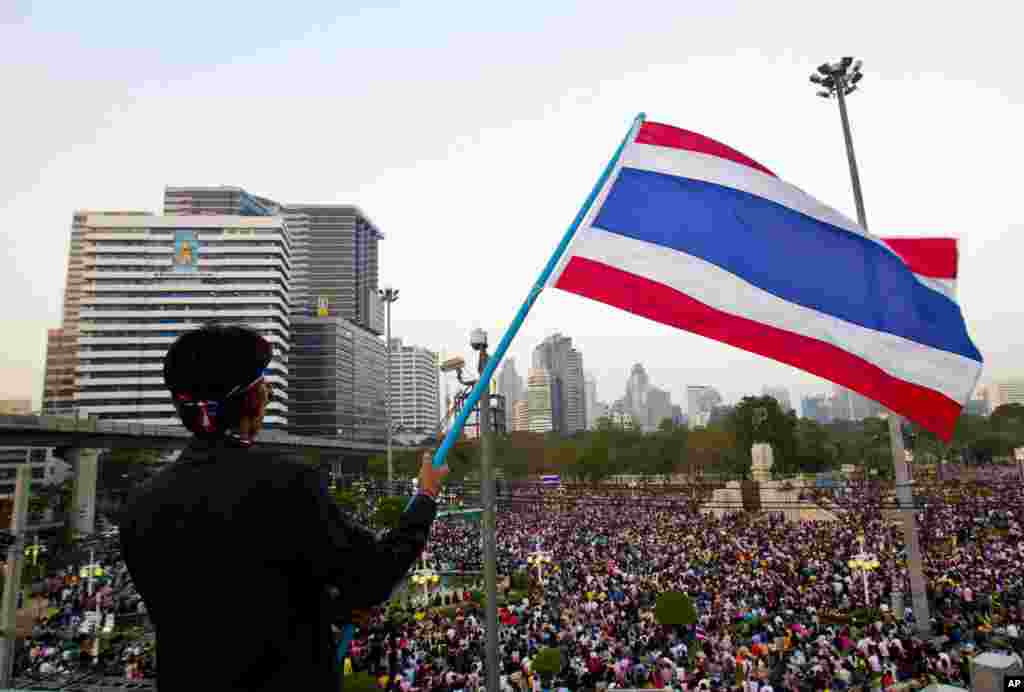
12/12Anti-government protesters carry a huge Thai national flag as they march in Bangkok, Dec. 9, 2013.
Show moreShow less
Previous slide
Next slide
While the government makes preparations for elections in less than 60 days, Yingluck's opponents continue to demand that the government instead be replaced by an unelected “people's council.”
As one of the more politically open countries in Southeast Asia, Thailand's political standoff has raised concerns abroad.
The U.S. State Department has issued a statement supporting the democratic process, including elections. Spokesperson Jen Psaki said Washington wants the situation resolved without further violence.
“Our focus here is on continuing to encourage a peaceful resolution of what’s happening on the ground in Thailand and certainly we’ve been watching closely as is evidenced by our statement. But there’s no implication there of any support for any side or anything along those lines,” stated Psaki.
In Beijing, China’s Foreign Ministry spokesman Hong Lei also expressed support for elections.
Hong said that “as a friendly neighbor China hopes the election will be conducted smoothly” and wants to “see that all parties operate within the constitution and the law.”
It remains unclear whether the opposition forces will boycott the election, in which they would be underdogs.
One of the opposition leaders, Suthep Thaugsuban, who resigned from the Democrat Party, has demanded civil servants report to the protest group instead of the government. Suthep, who faces arrest on insurrection charges, has also urged that volunteer neighborhood security forces be established to take over from the police, whom he considers to be corrupt and defenders of the government.