Accessibility links

Breaking News

US Urges Calm, Dialogue in Hong Kong

Protesters look their phones as they block the entrance to the offices of Hong Kong's Chief Executive Leung Chun-ying in Hong Kong, Oct. 2, 2014.
1/12 Protesters look their phones as they block the entrance to the offices of Hong Kong's Chief Executive Leung Chun-ying in Hong Kong, Oct. 2, 2014.
Leung Chun-ying, commonly known as CY Leung, chief executive of Hong Kong, appointed July 1, 2012. (screen grab from Channel 4, UK television, Oct. 2, 2014)
2/12 Leung Chun-ying, commonly known as CY Leung, chief executive of Hong Kong, appointed July 1, 2012. (screen grab from Channel 4, UK television, Oct. 2, 2014)
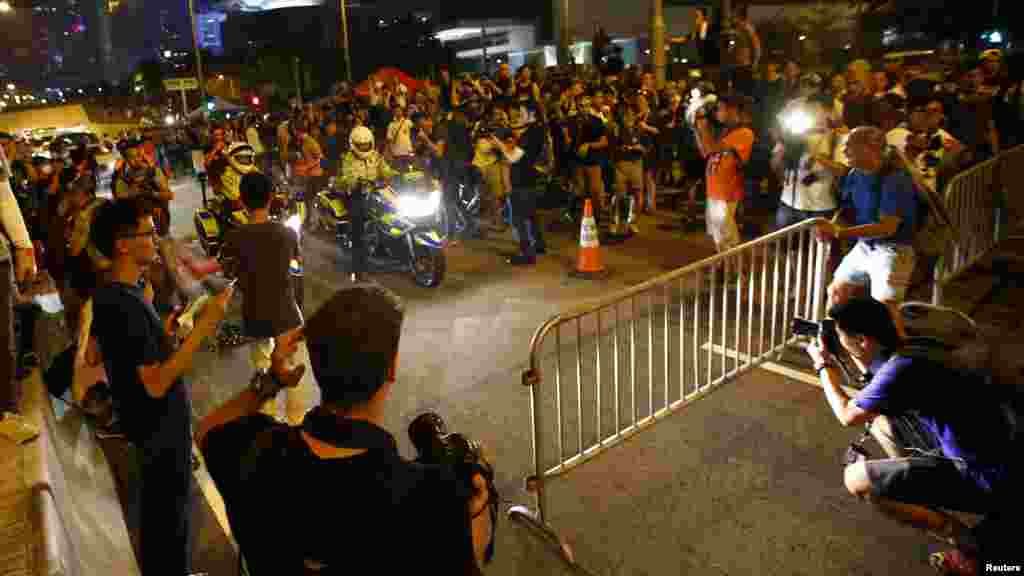
Protesters try to block an avenue outside the offices of Hong Kong's Chief Executive Leung Chun-ying in Hong Kong, Oct. 2, 2014.
3/12 Protesters try to block an avenue outside the offices of Hong Kong's Chief Executive Leung Chun-ying in Hong Kong, Oct. 2, 2014.
A woman looks at notes left by pro-democracy protesters on a footbridge in Hong Kong, Oct. 2, 2014.
4/12 A woman looks at notes left by pro-democracy protesters on a footbridge in Hong Kong, Oct. 2, 2014.
Activists in support of the pro-democracy demonstrations in Hong Kong protest in front of the Chinese Consular office in Makati city, metro Manila, Oct. 2, 2014.
5/12 Activists in support of the pro-democracy demonstrations in Hong Kong protest in front of the Chinese Consular office in Makati city, metro Manila, Oct. 2, 2014.
Police officers, seen behind yellow ribbons representing "universal suffrage", guard the entrance of the government headquarters building as protesters block the surrounding streets in Hong Kong, Oct. 2, 2014.
6/12 Police officers, seen behind yellow ribbons representing "universal suffrage", guard the entrance of the government headquarters building as protesters block the surrounding streets in Hong Kong, Oct. 2, 2014.
Micha Benoliel, CEO and co-founder of Open Garden, takes a picture on a main road that pro-democracy protesters have blocked at the Central financial district in Hong Kong, Oct. 2, 2014.
7/12 Micha Benoliel, CEO and co-founder of Open Garden, takes a picture on a main road that pro-democracy protesters have blocked at the Central financial district in Hong Kong, Oct. 2, 2014.
A student writes a message of support for the pro-democracy demonstrations and sticks it onto a wall in Hong Kong, Oct. 2, 2014.
8/12 A student writes a message of support for the pro-democracy demonstrations and sticks it onto a wall in Hong Kong, Oct. 2, 2014.
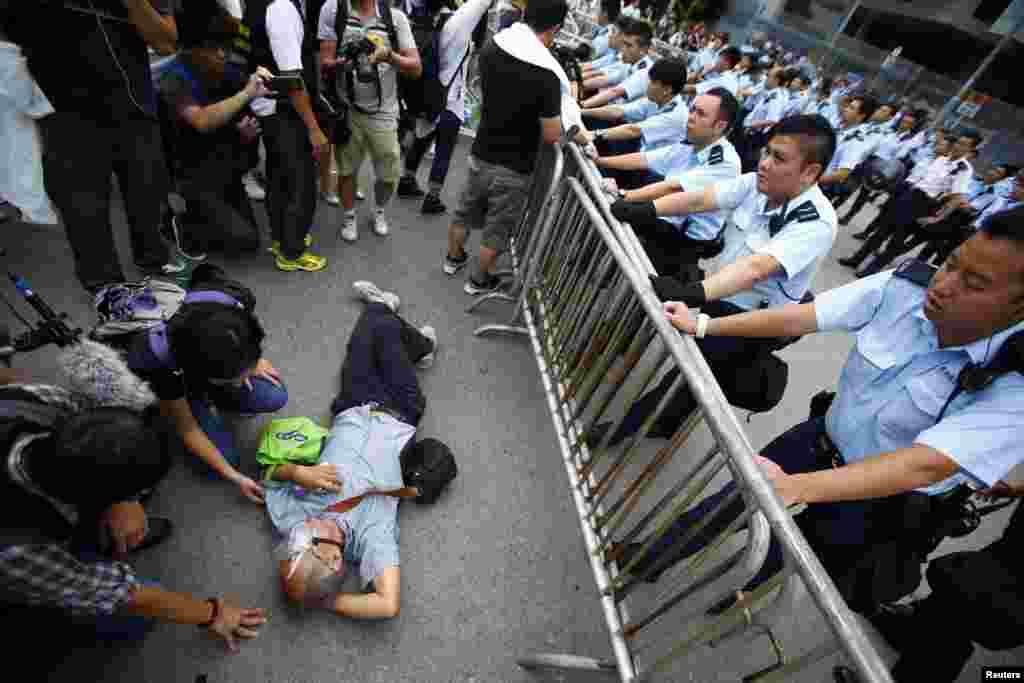
Police officers try to remove a protester from the entrance to Hong Kong's Chief Executive Leung Chun-ying offices next to the government headquarters building in Hong Kong, Oct. 2, 2014.
9/12 Police officers try to remove a protester from the entrance to Hong Kong's Chief Executive Leung Chun-ying offices next to the government headquarters building in Hong Kong, Oct. 2, 2014.
A protester sleeps under an umbrella on a street outside the government headquarters in Hong Kong, Oct. 2, 2014.
10/12 A protester sleeps under an umbrella on a street outside the government headquarters in Hong Kong, Oct. 2, 2014.
Demonstrators hold umbrellas in support of Hong Kong's pro-democracy movement at Times Square in New York, Oct. 1, 2014.
11/12 Demonstrators hold umbrellas in support of Hong Kong's pro-democracy movement at Times Square in New York, Oct. 1, 2014.
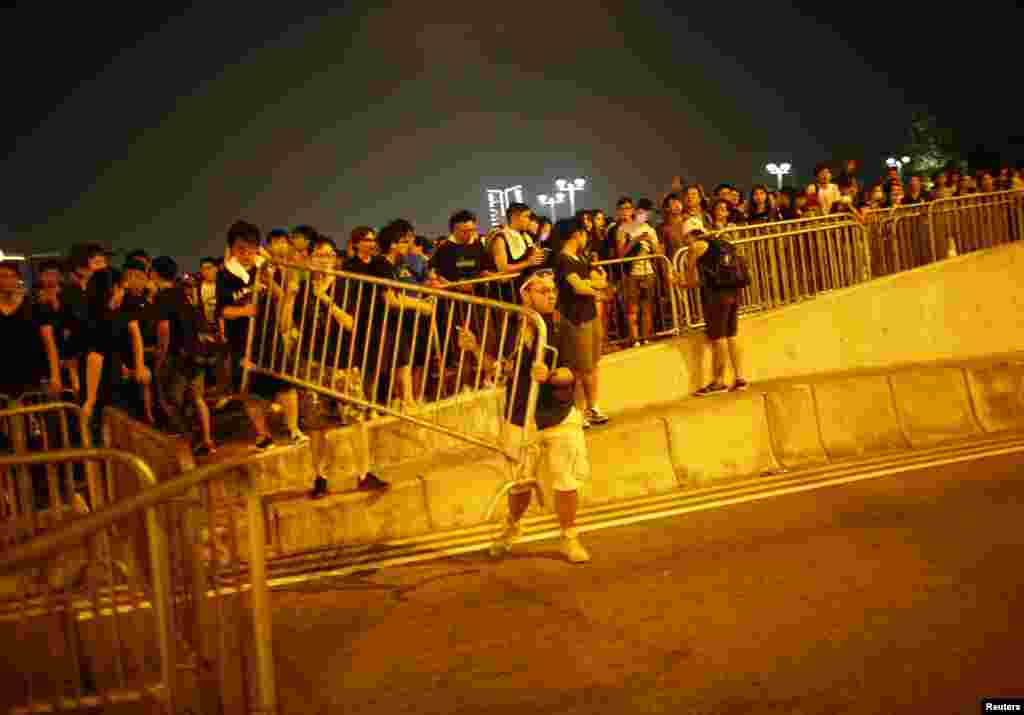
Protesters try to block an avenue with metal fences outside the offices of Hong Kong's Chief Executive Leung Chun-ying in Hong Kong, Oct. 2, 2014.
12/12 Protesters try to block an avenue with metal fences outside the offices of Hong Kong's Chief Executive Leung Chun-ying in Hong Kong, Oct. 2, 2014.
Previous slide
Next slide

The United States is urging authorities and demonstrators in Hong Kong to engage in dialogue to end the massive protests that have choked Hong Kong thoroughfares for the past week. The protesters, angered by China's insistence that only its handpicked candidates can run in coming elections, have threatened to take over government buildings.

The State Department says the U.S. continues to maintain its open line of communication with China.

Spokeswoman Jen Psaki says the U.S. wants both sides to exercise caution and pursue ways to resolve the dispute.

“We would certainly be concerned if there is an escalation by authorities. We will see what happens, but we will continue to encourage that and urge restraint in all our conversations.”

She commented on Thursday, a day after Secretary of State John Kerry and his Chinese counterpart, Wang Yi, held talks on a wide range of issues, including the protests.

During a joint appearance with Kerry, China's foreign minister made it clear that any outside interference in the unrest would not be welcomed.

“Hong Kong's affairs are China's internal affairs. All countries should respect China's sovereignty, and this is also a basic principle governing international relations," said Wang Yi.

China considers the protests illegal. Police have warned of serious consequences if demonstrators try to surround or occupy buildings.

Psaki would not say if an escalation in the use of force against the pro-democracy demonstrators would result in a shift in U.S.-China policy.

“I am not going to get ahead of where we are. Certainly, we hope that is not the case," she said.

The White House says President Barack Obama has also underscored U.S. hopes for a peaceful resolution of the standoff.

The issue could receive more attention when the president opens a three-day visit to Beijing next month.

This item is part of
XS
SM
MD
LG