Accessibility links

Breaking News

New NASA Images Reveal Pluto’s Terrain

This synthetic perspective view of Pluto, based on the latest high-resolution images to be downlinked from NASA’s New Horizons spacecraft, shows what you would see if you were approximately 1,100 miles (1,800 kilometers) above Pluto’s equatorial area, loo

NASA has released incredibly detailed images of Pluto taken by the New Horizons spacecraft in July during its historic flyby.

The stunning photos reveal a complex and varied terrain on the icy dwarf planet.

The photos show the oldest terrain spotted on Pluto, which is heavily cratered as well as newer terrain characterized by icy plains.

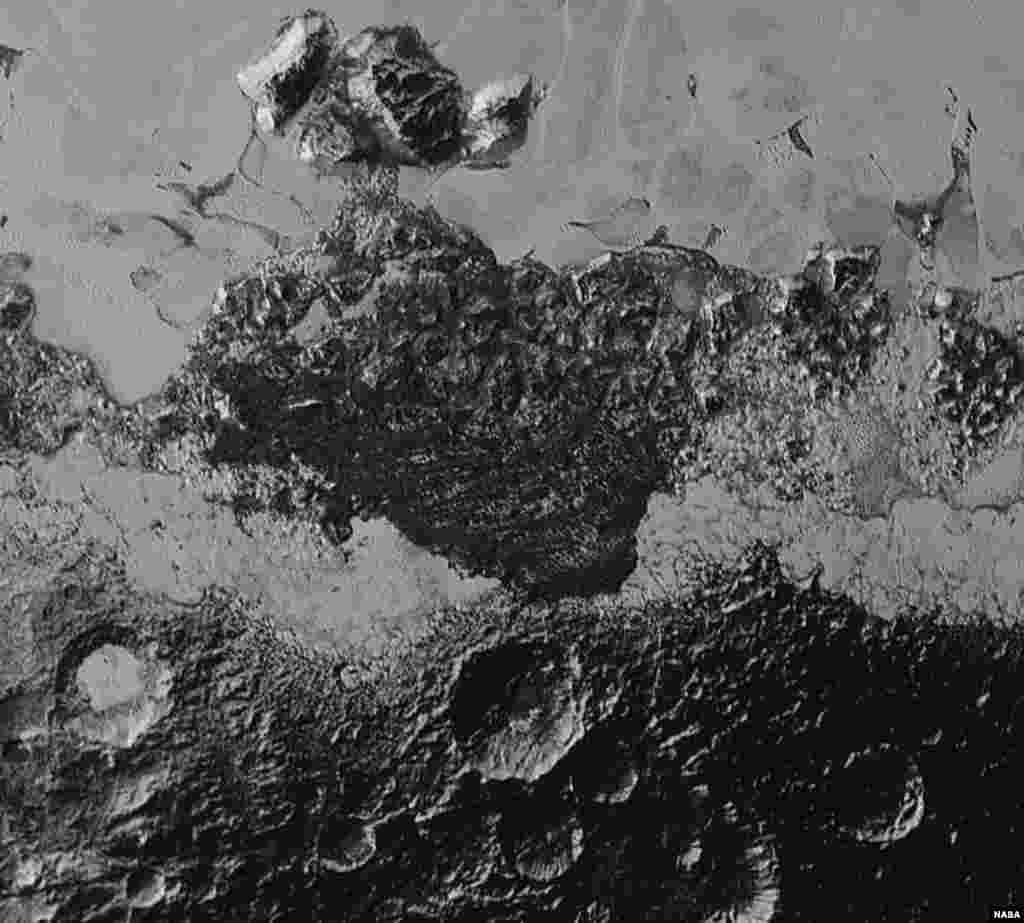
“The surface of Pluto is every bit as complex as that of Mars,” said Jeff Moore, leader of the New Horizons Geology, Geophysics and Imaging team at NASA’s Ames Research Center, in a statement. “The randomly jumbled mountains might be huge blocks of hard water ice floating within a vast, denser, softer deposit of frozen nitrogen within the region informally named Sputnik Planum.”

The pictures, some at a resolution of up to 400 meters per pixel, show features like possible dunes, nitrogen ice flows and “networks of valleys that may have been carved by material flowing over Pluto’s surface,” according to a news release.

High-Resolution Pluto Images
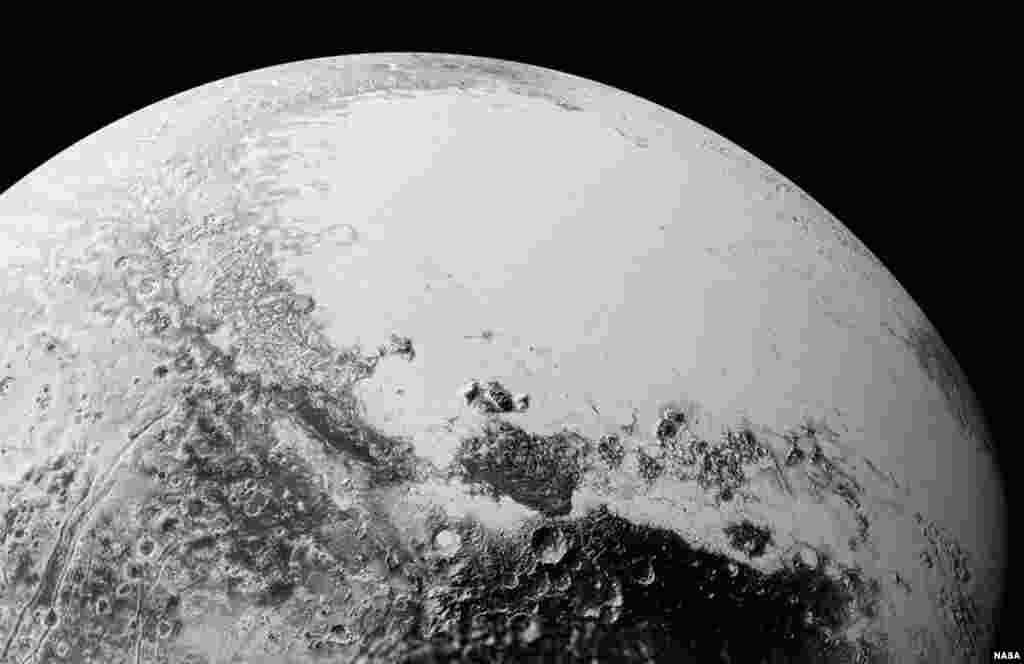
This synthetic perspective view of Pluto, based on the latest high-resolution images to be downlinked from NASA’s New Horizons spacecraft, shows what you would see if you were approximately 1,100 miles (1,800 kilometers) above Pluto’s equatorial area, loo
1/5 This synthetic perspective view of Pluto, based on the latest high-resolution images to be downlinked from NASA’s New Horizons spacecraft, shows what you would see if you were approximately 1,100 miles (1,800 kilometers) above Pluto’s equatorial area, loo
This 220-mile (350-kilometer) wide view of Pluto from NASA’s New Horizons spacecraft illustrates the incredible diversity of surface reflectivities and geological landforms on the dwarf planet. The image includes dark, ancient heavily cratered terrain; br
2/5 This 220-mile (350-kilometer) wide view of Pluto from NASA’s New Horizons spacecraft illustrates the incredible diversity of surface reflectivities and geological landforms on the dwarf planet. The image includes dark, ancient heavily cratered terrain; br
This image of Pluto’s largest moon Charon, taken by NASA’s New Horizons spacecraft 10 hours before its closest approach to Pluto on July 14, 2015 from a distance of 290,000 miles (470,000 kilometers), is a recently downlinked, much higher quality version
3/5 This image of Pluto’s largest moon Charon, taken by NASA’s New Horizons spacecraft 10 hours before its closest approach to Pluto on July 14, 2015 from a distance of 290,000 miles (470,000 kilometers), is a recently downlinked, much higher quality version
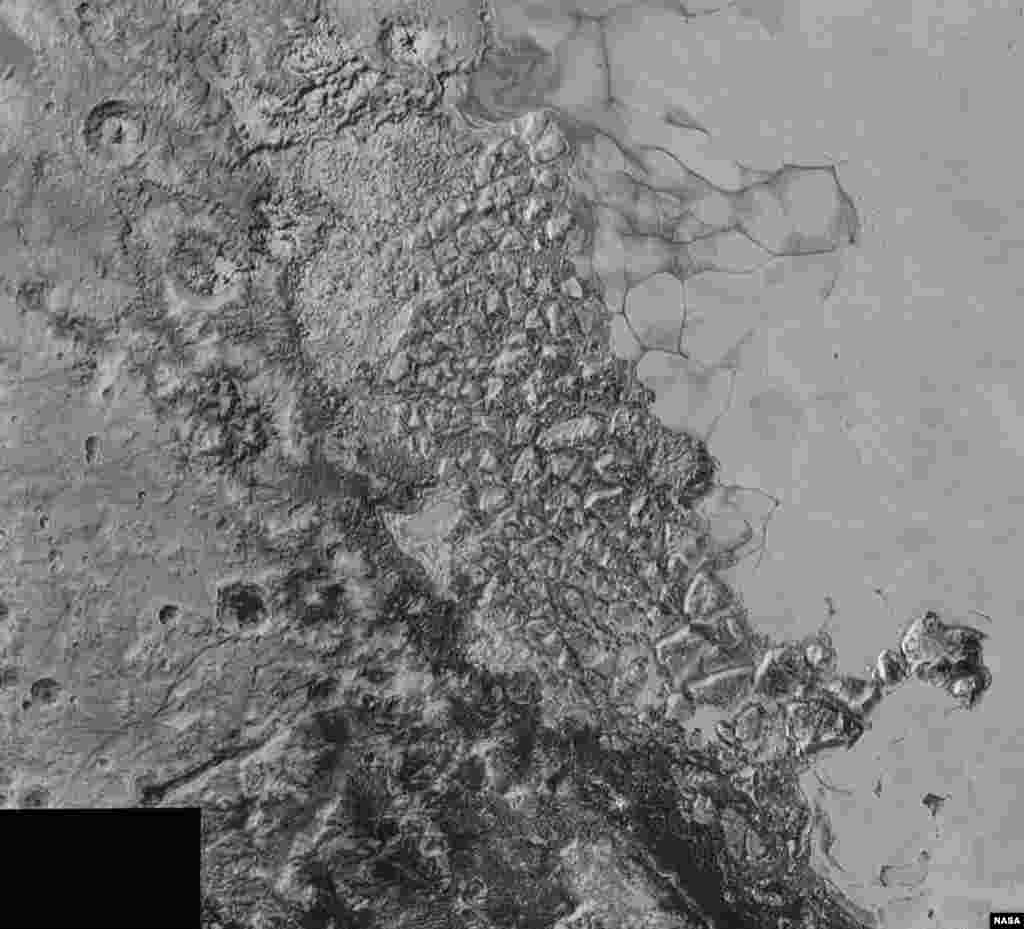
In the center of this 300-mile (470-kilometer) wide image of Pluto from NASA’s New Horizons spacecraft is a large region of jumbled, broken terrain on the northwestern edge of the vast, icy plain informally called Sputnik Planum, to the right. The smallest visible features are 0.5 miles (0.8 kilometers) in size. This image was taken as New Horizons flew past Pluto on July 14, 2015, from a distance of 50,000 miles (80,000 kilometers).
4/5 In the center of this 300-mile (470-kilometer) wide image of Pluto from NASA’s New Horizons spacecraft is a large region of jumbled, broken terrain on the northwestern edge of the vast, icy plain informally called Sputnik Planum, to the right. The smallest visible features are 0.5 miles (0.8 kilometers) in size. This image was taken as New Horizons flew past Pluto on July 14, 2015, from a distance of 50,000 miles (80,000 kilometers).
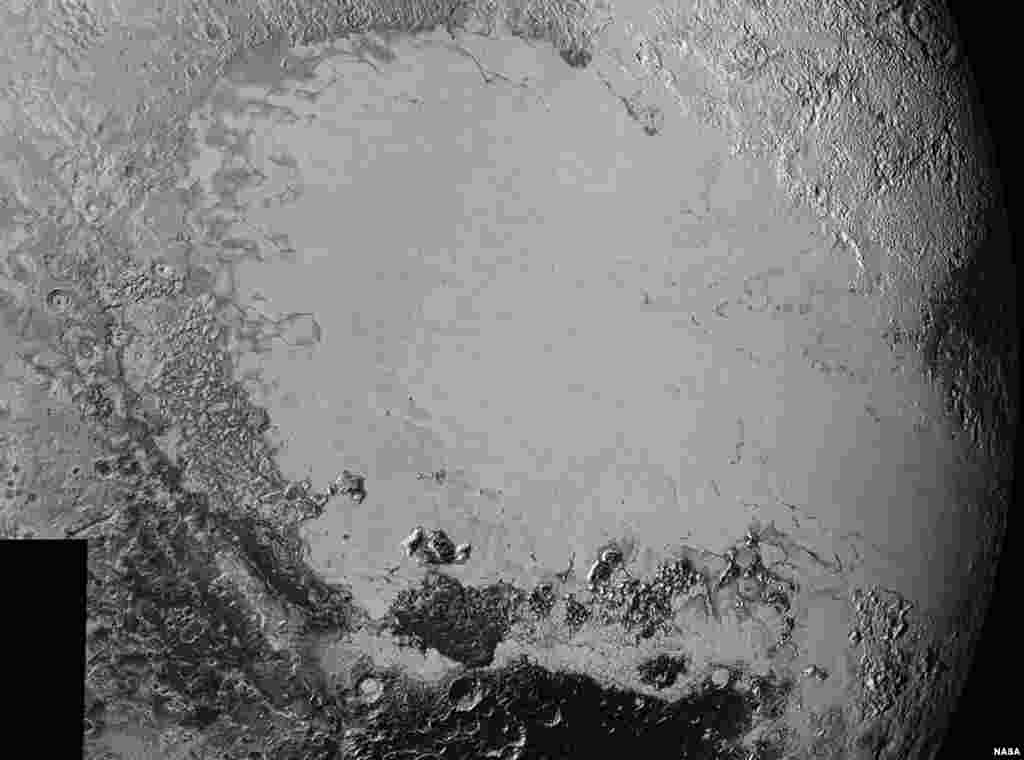
Mosaic of high-resolution images of Pluto, sent back from NASA's New Horizons spacecraft from Sept. 5 to 7, 2015. The image is dominated by the informally-named icy plain Sputnik Planum, the smooth, bright region across the center. This image also features a tremendous variety of other landscapes surrounding Sputnik.
5/5 Mosaic of high-resolution images of Pluto, sent back from NASA's New Horizons spacecraft from Sept. 5 to 7, 2015. The image is dominated by the informally-named icy plain Sputnik Planum, the smooth, bright region across the center. This image also features a tremendous variety of other landscapes surrounding Sputnik.
Previous slide
Next slide

There are also “chaotically jumbled” mountains NASA says may be similar to terrain seen on Jupiter’s moon, Europa.

“Seeing dunes on Pluto -- if that is what they are -- would be completely wild, because Pluto’s atmosphere today is so thin,” said William B. McKinnon, a GGI deputy lead from Washington University, St. Louis, in a statement. “Either Pluto had a thicker atmosphere in the past, or some process we haven’t figured out is at work. It’s a head-scratcher.”

Another source of surprise has been the revelation that Pluto’s thin atmospheric haze has many more layers than previously thought.

  • 16x9 Image

    VOA News

    The Voice of America provides news and information in more than 40 languages to an estimated weekly audience of over 326 million people. Stories with the VOA News byline are the work of multiple VOA journalists and may contain information from wire service reports.

XS
SM
MD
LG